


Egyptians working abroad sent home $47.3bn in fiscal year (FY) 2025/26, according to preliminary balance-of-payments figures from the Central Bank of Egypt (CBE), up 29.6% from $36.5bn a year earlier. Over the same twelve months, tourism brought in $18.4bn and Suez Canal transit receipts $4.4bn. Remittances were worth roughly twice those two sources combined.
Separate calendar-year figures also show growth. The CBE reported $33.9bn of remittances between January and August 2026, an increase of 27.2% from $26.6bn in the same months of 2025. August alone brought in $4.2bn. Three years earlier, recorded inflows had been falling sharply.
Why recorded remittances fell in 2023
World Bank data show recorded remittances to Egypt at $31.5bn in 2021, $28.3bn in 2022 and $19.5bn in 2023. These are calendar-year totals, separate from the fiscal-year figures published by the CBE.
The World Bank identified the gap between the official exchange rate and the parallel market as a likely reason why some remittances were no longer being recorded. Its December 2023 review said that this gap probably left a substantial part of the flows outside official statistics. In June 2024, it again linked the divergence in rates to transfers moving through unofficial channels.
The distinction matters when reading the fall. A decline in recorded remittances does not, by itself, show that families abroad stopped sending the same amount of money. Some of the change can reflect which channels people use.
What changed after the March 2024 reforms
On 6 March 2024 the CBE raised its policy rate by 600 basis points. The International Monetary Fund, announcing a staff-level agreement on Egypt’s lending programme that day, welcomed both the rate increase and the unification of the official and parallel exchange rates as the start of a move towards a flexible exchange-rate regime.
By June 2024, the World Bank was reporting that official remittance flows to Egypt had rebounded after the rates were unified. Its annual series subsequently recorded $29.6bn in 2024 and $41.5bn in 2025. The latter is the highest calendar-year total in that series, which begins in 1977. Remittances were equivalent to 11.4% of gross domestic product in 2025, compared with 4.9% in 2023.
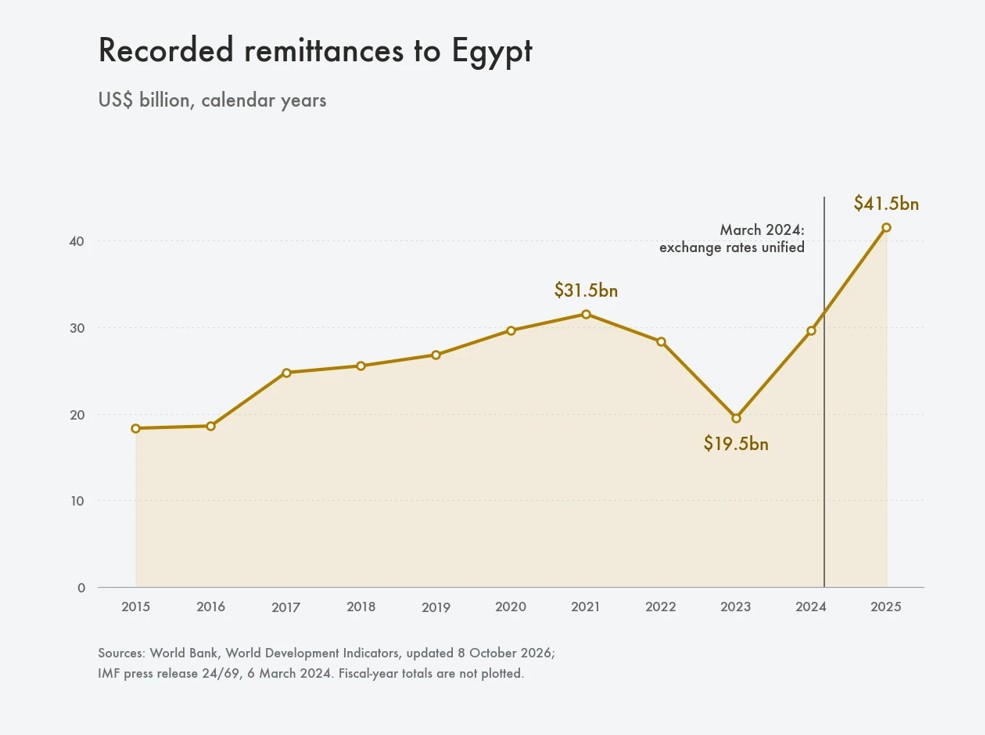
Recorded personal remittances received by Egypt, in calendar years. Source: World Bank, World Development Indicators, updated 8 October 2026. Reform date: IMF press release 24/69.
What it costs to send money to Egypt
Remittance costs include the upfront fee and the margin in the exchange rate offered to the sender. The World Bank’s Remittance Prices Worldwide survey compares these costs for sending about $200. In the third quarter of 2025, its latest published survey round, the average costs on four routes to Egypt were:
| Sending country | Average total cost |
| Kuwait | 3.33% |
| United Arab Emirates | 3.70% |
| Saudi Arabia | 5.15% |
| United States | 5.36% |
The global average in the same round was 6.36%. The G20’s remittance-cost targets call for a global average of no more than 3% for sending $200 by 2030, with no corridor above 5%. The Saudi Arabia and United States routes in this survey were still above that future corridor target. These are surveyed averages, rather than a quote for a particular transfer.
What a recipient can check when a bank transfer is late
For an international bank payment sent over Swift, ask the sender for the UETR on the bank’s payment confirmation. The Unique End-to-end Transaction Reference is a 36-character identifier that stays unchanged as intermediary banks pass the instruction on. A money transfer company’s own reference follows that company’s system and is a different type of tracking number.
Reaching the receiving bank and crediting the customer’s account are separate stages. Swift says 75% of cross-border payments on its network reach beneficiary banks within ten minutes. It estimates that the final domestic stage can account for around 80% of total processing time. Those network-wide figures do not set a delivery deadline for an individual transfer to Egypt.
Recipients can use uetr.ai’s guide to tracking an international wire transfer to identify the reference they need and check the reported status. uetr.ai is an independent payment-tracking service with a free status check. An online lookup does not replace a payment trace requested through the sending bank.
If the account is still not credited, the recipient can raise the missing payment with the receiving bank while the sender asks their own bank to trace it. Banque Misr’s published complaint procedure, for example, provides a complaint reference within two working days and a first response within 15 working days, with longer periods possible for cases involving outside parties.
A customer who rejects that response must notify Banque Misr in writing within 15 working days. The bank then has 15 working days to reconsider and give its final response. Its procedure allows escalation to the CBE if the second, final response is unacceptable, or if the bank does not reply within the prescribed or notified period.


