

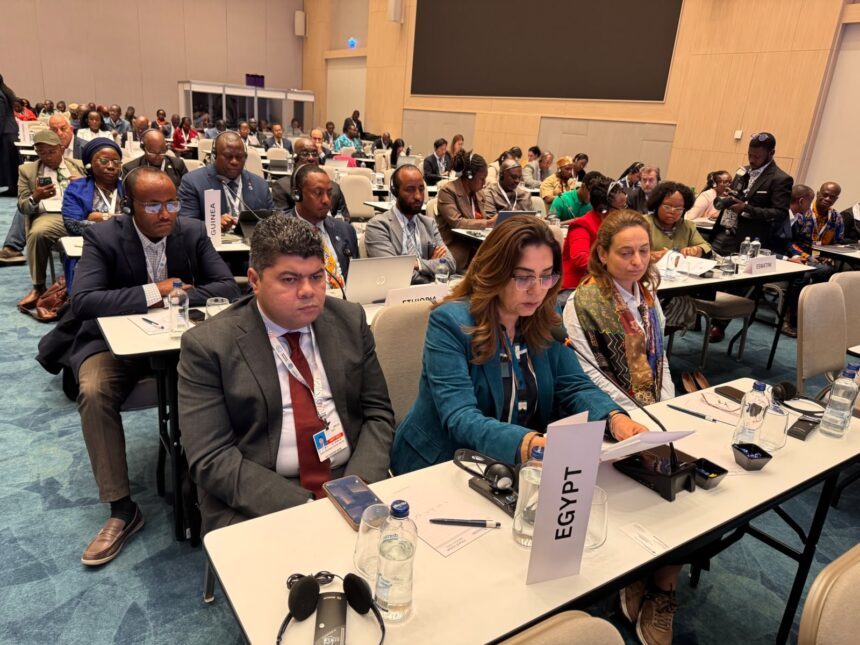
African countries should not be expected to take on additional climate obligations without the financing, technology transfer and capacity building needed to fulfil them, Egyptian Environment Minister Manal Awad said, calling for adaptation finance to be tripled by 2035 and greater resources allocated to addressing loss and damage.
Awad made the remarks during a high-level consultative meeting of African environment ministers in Antalya on the sidelines of COP31, where officials discussed coordinating the continent’s positions during the final phase of climate negotiations.
She said the success of COP31 should be measured by its ability to translate existing commitments into tangible action and implementation, rather than produce additional pledges unsupported by adequate financing and delivery mechanisms.
Awad said Egypt and the African Group were working to ensure that developed countries uphold their climate-finance obligations under Article 9 of the Paris Agreement, with funding that is concessional, predictable and accessible.
She stressed the need to prioritise grants and financing mechanisms that do not add to African countries’ debt burdens, arguing that the continent cannot be expected to raise its climate ambition without the necessary resources to implement its commitments.
Adaptation finance and loss and damage
Awad described climate adaptation as an existential priority for Africa, calling for a clear pathway to triple adaptation finance by 2035 and for progress on the Global Goal on Adaptation and the Baku Adaptation Roadmap.
She also urged greater funding for the Fund for Responding to Loss and Damage, alongside faster and more direct access to its resources for developing countries and climate-vulnerable communities.
On the just transition, Awad said Africa’s shift towards lower-carbon economies must not come at the expense of its right to development. She stressed that any practical mechanism should be supported by adequate financing, technology transfer and capacity building.
She also expressed concern over unilateral climate-related trade measures, warning that such policies should not become instruments of trade restriction against developing countries or undermine Africa’s ability to participate in green industries, technologies and value chains.
Awad said the final COP31 decision should strike a balance between mitigation, adaptation, climate finance, loss and damage, technology transfer and capacity building, while upholding the principles of equity and common but differentiated responsibilities.
She also called on African countries to maintain a unified negotiating position and avoid trade-offs between key priorities, particularly climate finance, adaptation and mitigation.
African coordination ahead of COP31 outcome
UN Environment Programme Executive Director Inger Andersen said Africa needed increased financing for adaptation and loss and damage, noting that the continent faces growing climate impacts despite contributing a relatively small share of global greenhouse gas emissions.
Andersen also highlighted Africa’s potential in renewable energy and green development.
African Union Commissioner for Agriculture, Rural Development, Blue Economy and Sustainable Environment Moses Vilakati called for stronger climate governance across the continent and closer coordination among the African Union Commission, the African Ministerial Conference on the Environment and the African Group of Negotiators.
In remarks delivered on behalf of UN climate chief Simon Stiell, negotiators were urged to make progress during the second week of COP31 on outstanding issues, including the just transition mechanism, the Global Goal on Adaptation, climate finance and technology transfer.
Hanan Morsy, Deputy Executive Secretary of the UN Economic Commission for Africa, called for closer coordination among African environment, finance, planning and economic development ministers, stressing the need to integrate climate risks into national economic policies and budgets.
She said preparations were under way for a joint meeting of African environment, finance, planning and economic development ministers in Addis Ababa in March 2027.
Ghanaian Environment, Science and Technology Minister Zanetor Agyeman-Rawlings also called for existing climate-finance commitments to be honoured and for resources to support the implementation of nationally determined contributions. She further stressed the importance of ensuring that Africa derives greater benefits from its critical minerals, green manufacturing and fair carbon markets.
Participants agreed to maintain political and technical coordination throughout the remaining COP31 negotiations, focusing on climate finance, adaptation, loss and damage and the just transition.


