

On 22 October 2026, Kathak Sandhya brought the rhythms and vibrancy of Indian classical dance to Cairo’s Gomhoria Theatre. Organised by the Embassy of India in Egypt, the evening featured performers of different ages and nationalities, accompanied by live musicians. The Bollywood selections revealed how deeply Indian popular culture has entered Egypt’s cultural imagination, as Egyptian performers and audience members sang along to the lyrics. The evening culminated in a solo by Kathak exponent Ms Sonam Chauhan, who took on the artistic challenge of interpreting a song by musical legend Oum Kalthoum. Her remarkable performance captured the music’s emotional nuances, bringing two rich artistic traditions into a moving dialogue. In Kathak, the interplay between the tabla and the dancer is known as sawal-jawab, or question and answer. A rhythmic phrase is offered, answered through footwork and returned in a new variation. The exchange is as much about listening as it is about movement: each response builds on what came before, creating new possibilities—a fitting starting point for considering the relationship between Egypt and India.
In the twentieth century, Egypt and India confronted the challenge of securing meaningful independence in a world shaped by imperial legacies and competing centres of power. Their histories differed, but their anti-colonial struggles raised a common question: what did sovereignty mean if newly independent nations remained unable to determine their economic and diplomatic priorities? Mahatma Gandhi and Saad Zaghloul became enduring figures in their respective nationalist struggles, both representing the determination of their peoples to shape their own futures. The partnership between President Gamal Abdel Nasser and Prime Minister Jawaharlal Nehru gave this aspiration an international stage. Egypt and India signed a Treaty of Friendship in April 1955, and their cooperation became closely associated with the Non-Aligned Movement (NAM), formally established in 1961 alongside leaders including Yugoslavia’s Josip Broz Tito and Indonesia’s Sukarno. Cairo hosted a preparatory meeting earlier that year, before the movement’s first summit in Belgrade. The enduring significance of this political fellowship is reflected in the streets named after Mahatma Gandhi, Jawaharlal Nehru and Dr Zakir Husain in Cairo, and Gamal Abdel Nasser Marg in New Delhi.
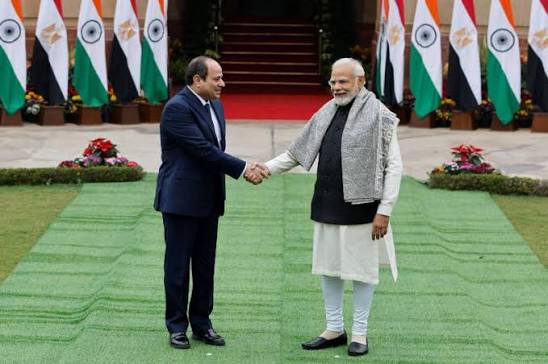
NAM expressed an important conviction: countries with distinct histories, political systems and regional priorities could work together to shape a more representative international order without surrendering their independence of judgement. Their solidarity could strengthen their ability to make choices on their own terms. That principle continues to inform bilateral ties. Egypt and India elevated their ties to a Strategic Partnership in 2023, while Egypt joined BRICS in January 2024. At the September 2026 BRICS summit in New Delhi, President Abdel Fattah El-Sisi and Prime Minister Narendra Modi discussed expanding bilateral trade and deepening cooperation, connecting contemporary economic ambitions to a longer history of political partnership. These developments have created further opportunities for cooperation between two countries with substantial regional influence and a shared interest in balancing the international order.

In a statement to this column, India’s Ambassador to Egypt, His Excellency Suresh K. Reddy, placed the partnership within the wider changes reshaping international affairs: “The shifting global paradigm presents complex challenges as conventional frameworks diminish in efficacy, yet it simultaneously creates meaningful opportunities for engagement and collaboration, specifically between India and Egypt. Leveraging our Strategic Partnership we are actively collaborating to influence this evolving world order for the mutual prosperity of our people and the broader Global South.” The Ambassador’s words capture an aspiration for shared prosperity that has stood the test of time and continues to find expression today.
The Red Sea connects Egypt to maritime networks reaching India’s western coast. During the Roman period, ports such as Berenike linked Egypt’s desert interior to the Indian Ocean, with ships following seasonal monsoon winds to reach distant markets. Archaeological excavations at Berenike have uncovered Buddhist statuettes, a terracotta soldier, a stele depicting Vrishni heroes and a dedicatory inscription in Sanskrit and Greek dated to AD 248. The second-century Muziris Papyrus links Indian ports to Egyptian and Mediterranean markets. The relationship between trade and craftsmanship is equally visible in cotton textiles produced in Gujarat, western India, during the thirteenth and fourteenth centuries and discovered near Fustat, Old Cairo. Their block-printed patterns, botanical and geometric designs, and rich red and indigo dyes demonstrate the sophistication of Indian textile production. Preserved by Egypt’s dry climate, these fragments provide rare evidence of fabrics that crossed the Indian Ocean and Red Sea, with some designs apparently customised for Egyptian consumers.
Centuries after Indian textiles first reached Egypt’s shores, industry continues to link the two countries. On 27 October 2026, the Embassy of India, the Cotton Textiles Export Promotion Council and the Alexandria Business Association gathered Indian textile companies and Egyptian industry representatives to explore opportunities across cotton yarn, denim, fibres and apparel. More than 700 Indian companies are registered in Egypt, with around 70 active across chemicals, energy, apparel, agriculture and automobiles. Their combined investments exceed US$5 billion, and a September 2026 memorandum to establish a joint Egyptian-Indian Chamber of Commerce would further facilitate networking, investment and industrial cooperation.
India’s Ayurveda and Egypt’s ancient medical traditions offer another perspective on the historical ties between the two civilisations. Both cultivated extensive knowledge of medicinal and aromatic plants, their preparation and their uses, preserved through generations of practice and written texts. Trade carried cures along with pharmacopoeial experience, linking Indian medicine with healing practices across Egypt and the Mediterranean. Today, the relationship finds a contemporary expression in pharmaceutical manufacturing, vaccine production and technology transfer. As global leaders in medicine production, Indian and Egyptian pharmaceutical companies actively collaborate to build state-of-the-art manufacturing plants, share advanced biotechnology, and conduct joint research into affordable therapeutics. The participation of 92 Indian pharmaceutical companies in Cairo’s Pharmaconex exhibition in 2026 highlighted the scope for stronger supply chains and improved access to medicines across Africa and Asia while creating opportunities for technology and knowledge transfer.
Food provides equally tangible reminders of the affinity between Egypt and India. One theory suggests that Egypt’s beloved koshari may have roots in the Indian khichdi, while the similarities between Egyptian falafel and Indian vada and dal-pakoras invite speculation about how fried legume dishes travelled between culinary traditions. Both countries have rich histories of vegetarian cooking shaped by religious fasting, with Indian puri bread finding popularity in Egyptian households. Trade across the Indian Ocean and Red Sea brought ingredients and influences into contact, enriching food traditions that already had deep roots in both civilisations. The warming notes of ginger, cumin, coriander and fenugreek evoke the distinctive yet familiar flavours of Egyptian and Indian cooking, with archaeological evidence of Indian peppercorns in Egypt dating to the reign of Ramesses II. The two cultures also share culinary techniques, as seen in the Egyptian method of toasting spice blends, in parallel with the ancient Indian practice of tempering spices in hot fat to release their essential oils. These parallels extend to familiar ingredients and staples, from Egyptian samna and Indian ghee to the fragrant fats that form the foundation of both cuisines.
The Egyptian sambousek and Indian samosa share a culinary ancestry in the medieval Persian triangular pastry known as sanbosag, while Egypt’s Hindi mango, introduced from India in the nineteenth century, shows how a fruit can cross oceans, take root in new soil and become a fast favourite. And always, there is tea: chai in India and shay in Egypt both trace their linguistic origins to the Chinese word chá. Both societies developed a fondness for boiling strong black tea with generous amounts of milk and sugar, giving rise to masala chai in India and shay bi laban in Egypt as quintessential comfort beverages. Perhaps the most enduring connection lies not in proving who borrowed what, but in the way both cultures make food a language of familiarity: a taste that travels, adapts and, eventually, feels as though it has always belonged.
India’s diaspora numbers more than 35 million worldwide, while Egypt’s is estimated at over 11 million. Both communities contribute far beyond remittances to support development at home. India’s experience offers a useful lesson in widening participation: alongside its flagship biennial convention at home, it has organised regional diaspora conferences on a rotating basis across host countries, bringing engagement closer to diaspora communities abroad. Cultural exchange remains an important bridge between our societies. Established in Cairo in 1992, the Maulana Azad Centre for Indian Culture has sustained this engagement. In January 2026, Egypt participated as a partner country at India’s Surajkund International Crafts Mela, bringing Egyptian artisans, craftspeople and performers to a major showcase of traditional craftsmanship. Attracting more than a million visitors over its fortnight, the fair introduced Indian audiences to Egypt’s material traditions, including copperwork and textiles.
Popular culture offers another point of connection. Indian cinema and television have long found devoted audiences in Egypt: Amitabh Bachchan’s Mard (1985), for instance, played in Egyptian cinemas for two consecutive years amid sustained audience demand, while more recently the Arabic-dubbed romance drama Iss Pyaar Ko Kya Naam Doon?, locally titled Min Al-Nazrah Al-Thaniya, found considerable success. Modern reality shows such as Family Karma and Bollywed also resonate with Egyptian experiences both at home and abroad whose own experiences of family expectations, cultural belonging and diasporic identity are often similarly complex. Such stories help audiences recognise aspects of their own lives on screen, fostering a sense of familiarity and representation across cultural boundaries. These connections point to an organic civilisational kinship in which everyday values offer points of recognition. The adaptive resourcefulness of jugaad finds a parallel in the street-smart ingenuity of fahlawa; the hospitality of mehmani resonates with the generosity of karam; and the spiritual fellowship of satsang recalls the communal warmth of a lamma.
The Arabic ataba and Telugu gadapa share a phonetic resonance, as though the concept of a threshold echoes across both languages. In Telugu tradition, the gadapa can be adorned with muggu, intricate patterns drawn on the ground with colourful rice flour to mark a home’s entrance with beauty and welcome. The passing of time and footsteps disturb it, but its transience does not diminish its significance. Henna, cherished in celebrations in both India and Egypt, carries a similar poignancy. Its patterns gradually fade from the skin, while the joy of the occasion remains in memory. Whether a doorway, design or dance, a moment may pass while leaving an impression that endures.
At Gomhoria Theatre, the chakkar, or rapid spin, offered a compelling parallel with the relationship between Egypt and India. Despite successive rotations, the dancer maintained her balance by keeping her gaze fixed. So too have the two countries navigated a world of shifting alliances, competing powers and uncertainty, adapting to change while drawing on the strength of a friendship sustained by steady principles and priorities. The student performances also showed how individual achievement can become part of a larger composition: as one dancer took centre stage, her fellow performers seemed to direct audience attention towards her. Egypt and India share a similar spirit of generosity, with each country’s cultural achievements enriching the other’s flourishing. Looking ahead, it would be wonderful to see a collaboration between Kathak and Egypt’s tanoura or hagalla dance traditions.
In her 2025 novel Indian American novelist Kiran Desai writes through her protagonist: “This was India … You might try to write a slender story, but it inevitably connected to a larger one. The sense could never be contained.” Elsewhere, she evokes how, even after a day of troubles and obstacles, “dusk in India felt always settled, ancient, a civilization that had come to fullness.” There is something deeply familiar in this sensibility in Egypt. Two ancient civilisations, shaped by great rivers and layered histories, finding continuity amid change and familiarity across distance. Over centuries, Egypt and India continue to find in each other not merely a reflection of their past, but a threshold to a shared future.
Nadine Loza is a development strategist, opinion columnist, and Founding Director of the Egypt Diaspora Initiative.

