

As sea levels rise, beaches and wetlands are not the only natural assets at risk of disappearing beneath the water. Coastal flooding could also destroy valuable ecosystem services, from protecting shorelines and filtering water to producing food and regulating the climate.
A study published on 3 November in PNAS Nexus has sought to quantify the economic value of these losses, finding that rising sea levels could eliminate hundreds of billions of dollars’ worth of ecosystem services annually by the end of the century.
However, the damage is unlikely to be distributed equally. Countries that have historically contributed relatively little to global greenhouse gas emissions, including small coastal nations, could face disproportionately large losses relative to the value of their natural resources.
Shaoqing Long, an associate professor of environmental economics and sustainability at the School of Ecology at Sun Yat-sen University in China and the study’s lead author, said the research aimed to estimate the global scale of ecosystem-service losses, examine how these vary between countries and determine whether nations with lower historical emissions could bear a disproportionate share of the damage.
Ecosystem services are the benefits that nature provides to society, including food and water supplies, pollution removal, storm protection, carbon storage and tourism, Long explained.
How much could rising seas cost?
The researchers combined sea-level rise projections from the latest assessments of the Intergovernmental Panel on Climate Change (IPCC) with detailed global land-use maps and a database estimating the economic value of services provided by forests, farmland, wetlands, grasslands and other ecosystems.
Using a 2024 land-use map as their baseline, they estimated which areas could be submerged between 2030 and 2100 under five possible future pathways, ranging from strong emissions reductions to a high-emissions scenario.
They then calculated the annual value of ecosystem services that would be lost as land became submerged, adjusting future estimates to account for changes in income levels under each scenario.
Long explained that the team also compared each country’s cumulative per-capita greenhouse gas emissions between 1850 and 2024 with its projected per-capita losses in ecosystem services.
The results suggest that annual global losses could reach approximately $130bn in international dollars, expressed in 2020 values, under one scenario by 2100, rising to around $339bn under the highest-loss scenario. Under the intermediate scenario, annual losses would amount to approximately $164bn.
These figures do not represent amounts that governments would necessarily have to pay. Rather, they estimate the annual economic value of natural services that could disappear as rising seas inundate land.
The researchers also found that most losses would accumulate after 2060, suggesting that the damage could accelerate during the second half of the century.
Egypt and Iraq face substantial relative losses
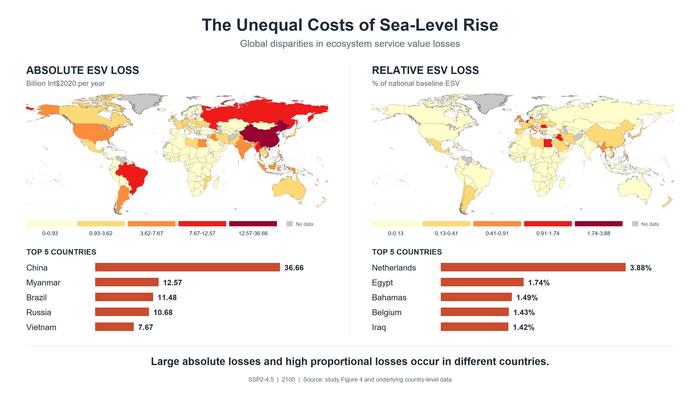
Under the intermediate scenario, China would experience the largest absolute economic losses, estimated at approximately $36.7bn in international dollars annually by 2100, followed by Myanmar, Brazil, Russia and Vietnam.
However, a different picture emerges when losses are measured as a proportion of each country’s total ecosystem-service value.
Low-lying coastal countries and those with major river deltas face particularly high relative losses. The Netherlands, Egypt, the Bahamas, Belgium and Iraq are among the countries projected to suffer the greatest proportional damage.
Kuwait, the UAE and Libya also feature among the 20 countries with the highest relative losses.
The study identifies wetlands as the ecosystem type most exposed in proportional terms, with losses potentially reaching approximately 2.2% under the highest-emissions scenario by 2100.
Meanwhile, agricultural land and built-up areas together account for around 59% to 60% of the total economic value of global losses.
Long explained that wetlands are particularly vulnerable because they are often located in low-lying areas, while farmland and urban developments occupy extensive and economically important coastal zones.
The findings highlight how rising sea levels could threaten not only natural habitats but also the benefits that coastal communities derive from them.
However, the researchers caution that their estimates are based on models rather than measurements of losses that have already occurred.
The flooding scenarios assume the absence of coastal barriers or future adaptation measures and do not fully account for the ability of coastlines and ecosystems to change naturally over time.
The study also groups coastal and inland wetlands into a single category, which could lead to an underestimation of coastal losses.
In addition, the researchers used a common economic adjustment factor to account for changes in income, without fully capturing substantial differences within individual countries.
For these reasons, the authors emphasise that the monetary estimates are intended to support comparisons between countries and help identify priorities for coastal protection and adaptation. They should not be interpreted as direct estimates of compensation costs or actual losses in human welfare.
The study suggests that the consequences of rising sea levels will extend well beyond the physical disappearance of coastal land, carrying potentially substantial economic and environmental implications for countries such as Egypt and Iraq, where vulnerable coastal areas support important natural services.


