
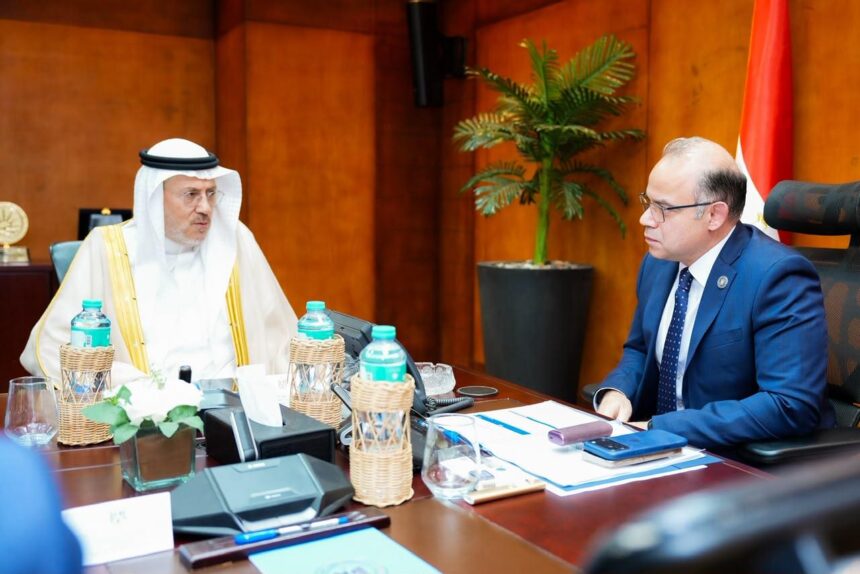
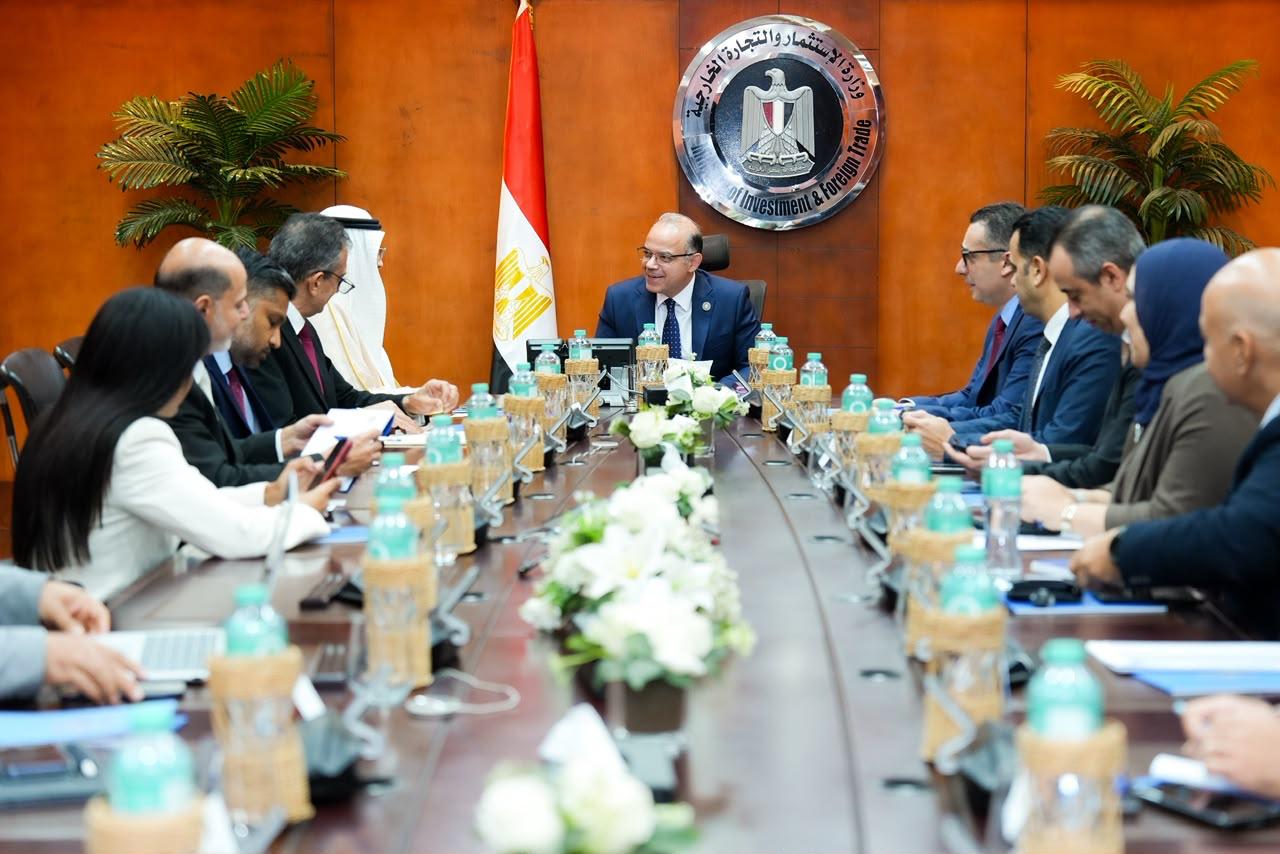
Minister of Investment and Foreign Trade Mohamed Farid met with Adeeb Yousuf Al-Aama, CEO of the International Islamic Trade Finance Corporation (ITFC), and an accompanying delegation to discuss ways to strengthen cooperation in export financing, start-up support, investment zone development, and the use of technology and artificial intelligence to promote foreign trade.
The meeting formed part of the ministry’s efforts to strengthen cooperation with international financial institutions and expand partnerships that support trade and investment.
It was attended by Mohamed Awad, CEO of the General Authority for Investment and Free Zones (GAFI); Alaa El-Beily, Chairperson of the General Authority for Exhibitions and Conferences; and Hatem El-Nawawy, CEO of the Export Development Authority.
Farid emphasised the importance of strengthening cooperation with the ITFC to support the establishment and operation of a regulatory sandbox for financial and trade technology, known as the Fintech Sandbox.
He described the sandbox as a platform for developing innovative solutions that leverage data, technology and artificial intelligence to support commercial and marketing activities and improve Egyptian companies’ access to international markets.
The minister explained that using artificial intelligence tools and digital agents in commercial and marketing activities could create new opportunities for exporters to reach non-traditional markets and increase their exports.
He also highlighted the importance of attracting start-ups and entrepreneurs to develop innovative technological solutions for the exporting community, while providing the necessary financing for companies participating in the sandbox.
This would help transform innovative ideas and solutions into viable, scalable business models, he said.
Farid further stressed the importance of expanding the activities of factoring companies by providing dedicated financing facilities for export-related factoring operations.
Such facilities would enable factoring companies to provide exporters with the liquidity they need and expand their financing portfolios. A greater focus on export-related factoring would also help increase the number of exporting companies and strengthen foreign currency inflows, he added.
He proposed that the Sovereign Fund of Egypt could serve as a central financing institution, receiving international funding and channelling it to factoring companies.
This arrangement would facilitate access to the resources needed to expand export financing activities. Farid affirmed the ministry’s readiness to coordinate with the relevant authorities to implement the proposed model.
Regarding investment zone development, Farid highlighted the importance of establishing more small and medium-sized investment zones near residential communities across Egypt’s governorates to promote local development and create employment opportunities, particularly for women.
He noted that women account for between 60% and 70% of the workforce in some of these zones, reflecting their contribution to women’s economic empowerment and the provision of employment opportunities suited to the characteristics of local communities.
Farid explained that the government aims to develop between 15 and 20 investment zones across the country, each covering between 20 and 80 feddans.
The zones would accommodate industrial, logistics, manufacturing and service activities through leasing arrangements and long-term usufruct rights.
He noted that several plots of land had been allocated in cooperation with the Ministry of Investment and Foreign Trade in preparation for their development.
The minister stressed the importance of accelerating the development of these zones through cooperation with specialised entities under public-private partnership (PPP) arrangements.
This model would allow developers and the state to participate in financing, helping accelerate project implementation and provide the infrastructure needed to attract investment and support the targeted activities.
Farid also emphasised the need to strengthen sector-specific knowledge in priority industries rather than focusing solely on promoting investment opportunities.
He said investment promotion officials must possess detailed knowledge of each sector, its requirements and its associated supply chains.
He noted that the foreign direct investment strategy prepared by the ministry in cooperation with the World Bank had identified 16 priority sectors, underscoring the need to develop investment promotion staff’s capabilities and provide them with the necessary technical and commercial expertise.
Farid further highlighted the importance of developing young professionals’ capabilities through specialised training programmes and professional qualifications to equip them with the required technical skills, improve workforce efficiency and support the implementation of joint cooperation objectives.
For his part, ITFC CEO Adeeb Yousuf Al-Aama reaffirmed the corporation’s commitment to supporting Egypt’s efforts to increase exports and develop trade financing and development instruments.
He expressed the corporation’s interest in expanding cooperation with Egypt in the coming period, particularly through the Egypt Country Programme for 2026–2027 under the Arab Africa Trade Bridges (AATB) initiative.
Al-Aama said the corporation was working to design tailored financing programmes to improve the efficiency of export-oriented businesses and help Egyptian companies enter new markets, strengthening their competitiveness and expanding the presence of Egyptian products in international markets.
He also emphasised the importance of closer cooperation to support exporting companies, develop their businesses and improve their operational efficiency, alongside building the capabilities of young professionals through specialised training programmes and professional qualifications.
At the conclusion of the meeting, Farid stressed that the government aims to make exporting a more attractive field for young people and entrepreneurs by encouraging innovation and developing commercial and technological solutions that generate economic returns and contribute to export growth.
He also highlighted the possibility of offering additional incentives to successful companies, including opportunities to participate in trade promotion missions and international exhibitions, discounts on services provided by GAFI, and access to data and information to support their business activities.