

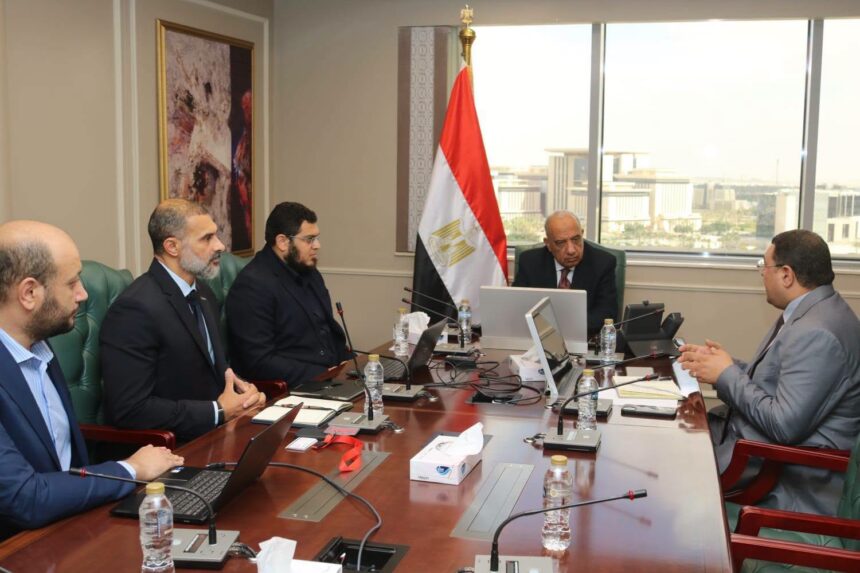
Mahmoud Esmat, Minister of Electricity and Renewable Energy, met with a delegation from Advanced Engineering Consultants (ADVEC), a company specialising in energy management, renewable energy integration and electricity grid solutions, headed by CEO Ahmed Salam. The meeting was attended by Ali Abdel Fattah, Chairperson of the Egyptian Electric Utility and Consumer Protection Regulatory Agency (EgyptERA).
The meeting discussed mechanisms for cooperation and partnerships in energy efficiency and digital solutions to support and strengthen the unified electricity grid. Discussions also covered support for the ‘Solar for Industry’ initiative and expanding the use of rooftops of government and private-sector buildings to install solar power plants.
The meeting was held within the framework of the National Energy Strategy and the Ministry of Electricity and Renewable Energy’s action plan to deploy modern technologies in energy integration and management. Discussions focused on supporting the energy transition, expanding renewable energy projects, reducing reliance on conventional fuels and their consumption, enhancing grid efficiency, ensuring economic operation, improving electricity supply quality, and maintaining the stability and sustainability of electricity services.
During the meeting, Esmat reviewed ADVEC’s areas of operation, expertise, track record and advanced digital technologies in the energy sector. These include solutions supporting digital transformation, as well as the planning, analysis and monitoring of electricity grid data.
He also highlighted the company’s advanced engineering solutions designed to address global developments and the challenges arising from greater reliance on renewable energy, while promoting environmental sustainability and improving the efficiency of natural resource utilisation. These efforts support the state’s energy transition objectives, including increasing reliance on renewable energy, transforming Egypt into a regional energy hub and achieving Egypt Vision 2030.
The meeting also addressed key operational and design challenges facing electricity transmission and distribution networks as a result of electromagnetic phenomena and harmonics, amid the growing integration of renewable energy generation systems and rising demand from non-linear loads. These factors can cause distortions in voltage and current waveforms.
The participants reviewed proposed solutions to mitigate the impact of these phenomena on electricity networks and ensure the security, stability and sustainability of power supply. They also discussed mechanisms for technical and technological cooperation with ADVEC in network planning and development, as well as integrating growing renewable energy capacities into the national electricity grid.
The meeting further explored the company’s advanced digital solutions for continuous, real-time power quality monitoring and precise analysis using artificial intelligence. These solutions rely on a smart metering network connected to an advanced digital platform for data collection and analysis, enabling operational power quality problems to be identified continuously and effectively. This approach offers an alternative to scattered, non-synchronised field measurements, which require considerable time and effort.
Esmat said that the development and modernisation plan, alongside grid studies, is an ongoing process, with work continuing in line with an integrated vision and clearly defined implementation plans.
He stressed that the ministry is working to achieve energy security, support digital transformation, analyse and monitor energy data, track the performance of renewable energy projects and assess production efficiency using the latest technologies and digital solutions aligned with the National Energy Strategy. These efforts form part of an action plan to improve institutional and operational efficiency and strengthen governance.
He explained that the transition from a conventional electricity grid to a smart grid is being implemented simultaneously across the generation, transmission and distribution sectors, particularly in the provision of services to citizens.
He stressed that upgrading, modernising and strengthening the unified electricity grid, while expanding its capacity to accommodate additional power generation, remain top priorities for improving service delivery and enhancing electricity supply quality.
Esmat also highlighted continued cooperation with private-sector partners under the energy transition plan and the National Energy Strategy, which aim to increase the share of renewable energy as a primary source of electricity within the energy mix.
He noted that achieving these objectives requires measures to safeguard the national electricity grid and ensure the stability and continuity of electricity supply.


