

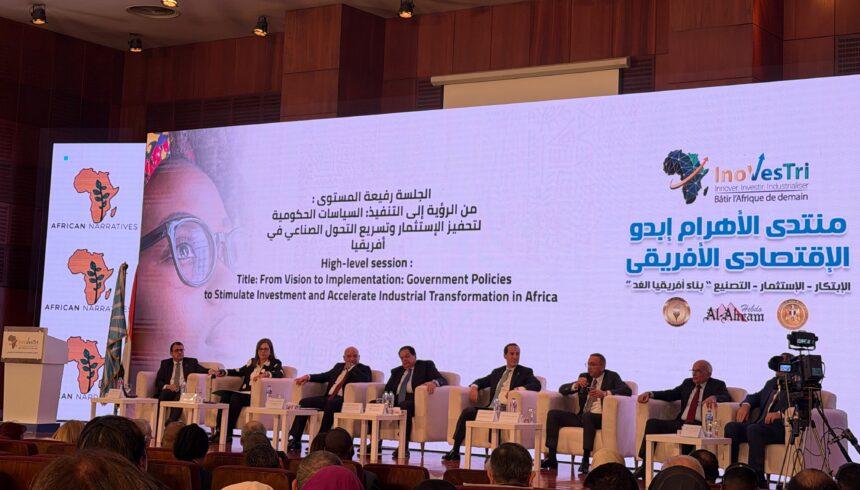
Egypt’s finance ministry is working on affordable risk insurance tools to protect Egyptian investors in Africa and other foreign markets, Finance Minister Ahmed Kouchouk told the second session of the InovesTri 2026 conference.
The session, titled “Made in Africa: From exporting raw wealth to making added value”, brought together Kouchouk, Planning and Economic Development Minister Ahmed Rostom, ambassadors and industry representatives to discuss manufacturing, investment protection, pharmaceuticals and logistics on the continent. It was moderated by broadcaster Ahmed Bashtou.
Kouchouk said the ministry wanted mechanisms that would encourage Egyptian companies to expand across the continent. He also said Egypt had formally launched an initiative for a “club of emerging countries”, which 31 countries have joined, 19 of them African.
Trade and investment
Rostom said the global economy faced uncertainty from geopolitical shifts and energy prices, and that regional integration would be one of the main pillars to rely on. He called for Africa to capture more value from its minerals and natural resources through manufacturing.
Egyptian exports to Africa stand at about $7.8bn, he said, while investment remains below its potential because of risks that need effective mechanisms to manage. He said there were moves towards integrating African financial markets, and that the African Union may develop trade and economic mechanisms closer to those of the European Union, with some steps already under way on easing payments.
Senegal’s ambassador to Egypt, Kimoko Diakité, urged Egyptian companies to look to West African markets, noting that there is no direct transport route between Egypt and the west of the continent, unlike its links with East Africa. He called for shipping links between Alexandria and Dakar and better road and air connections, and said Egyptian banks could join the Algerian, Moroccan and European banks already operating in Senegal.
He said security threats, chiefly terrorism in West Africa, weighed on investment, and pointed to the departure of Mali and Niger from the Economic Community of West African States (ECOWAS), adding that there were attempts to negotiate their return.
Pharmaceuticals
Maged George said Egypt should move from exporting medicines to investing and producing on the continent. He said studies of African pharmaceutical markets were under way and that work was proceeding on 12 factories to manufacture medicines jointly with African countries and transfer technology, with Egypt playing a leading role in training African staff.
Mohy Hafez, chairman of the Export Council for Medical Industries, said many African markets depend on imports, while Egyptian exports meet only a small share of their needs. He described the establishment of the African Medicines Agency in Rwanda as an important step towards unifying the licensing of factories and medicines across the continent. The main obstacle to pharmaceutical manufacturing in Africa was technical and production capacity, he said, adding that vaccines and rapid diagnostic tests were areas where Egypt had an edge. He said work was under way on approved Ebola test kits for the Democratic Republic of the Congo.
Sherine Helmy, chief executive of Pharco Pharmaceuticals, said expansion in Africa required projects with a real competitive advantage that can compete with countries that produce raw materials and control supply chains, and that innovation was the decisive factor. He said Egypt was now developing cancer treatments.
Mahmoud Abdel Fattah, deputy chairman of the Alexandria Port Authority, said Alexandria Port could play a major role in linking Egypt with markets across Africa.

