

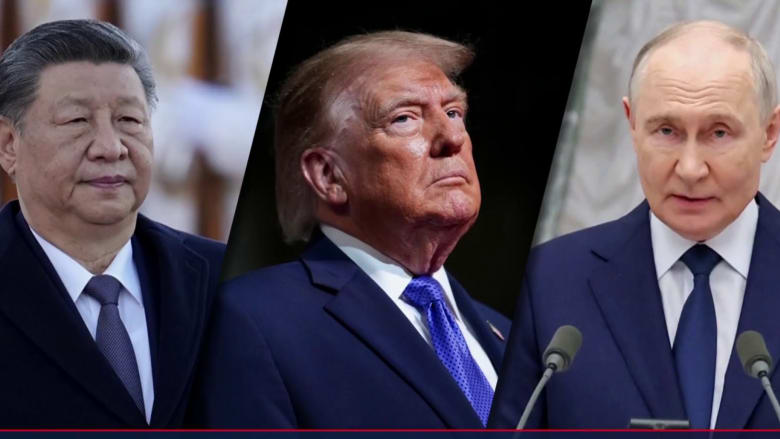
The prospect of a meeting between Donald Trump, Xi Jinping and Vladimir Putin has revived comparisons with the 1945 Yalta Conference. Yet the central question is not whether the world is about to be divided into new spheres of influence, but whether major powers are increasingly prepared to negotiate the limits of other states’ sovereignty without their participation.
The prospect of a meeting between US President Donald Trump, Chinese President Xi Jinping and Russian President Vladimir Putin in Shenzhen on the sidelines of the Asia-Pacific Economic Cooperation (APEC) summit has revived an unsettling historical analogy: the possibility of a “new Yalta”. The comparison is politically powerful. It evokes an image of three leaders sitting around a negotiating table, determining the future of the international system and the fate of countries whose interests may be directly affected by their decisions. Yet the analogy also risks obscuring the more complex dynamics shaping contemporary international politics.
The original Yalta Conference, held in February 1945, took place at a moment when the outcome of the Second World War was becoming increasingly clear and the victorious powers were negotiating the political arrangements of the post-war order. The conference addressed the occupation and reconstruction of Germany, the future of Poland, the establishment of the United Nations and the Soviet Union’s anticipated entry into the war against Japan. It became a lasting symbol of great-power diplomacy and the unequal distribution of influence, particularly because the post-war settlement contributed to the division of Europe. But Yalta did not simply divide the entire world into three predetermined territories. The subsequent Cold War order emerged through a much longer process of confrontation, negotiation, ideological competition and military consolidation.
That historical distinction matters. The international system of 2026 is not the system of 1945. The United States, China and Russia possess different forms of power, operate within a far more interconnected global economy and face constraints that did not exist in the same way at the end of the Second World War. The contemporary international order is shaped not only by military strength and territorial control, but also by financial networks, technological standards, supply chains, energy security, digital infrastructure and access to critical resources. Influence is exercised through multiple channels, many of which cannot be translated into clearly defined geographical spheres.

This does not mean that great-power competition has become less consequential. On the contrary, the ability of powerful states to shape the choices available to others remains a defining feature of international politics. What has changed is the form through which that influence is exercised. Rather than dividing the world into rigid blocs, major powers increasingly seek selective arrangements that protect their interests in particular regions or strategic domains. These may involve tacit understandings over military escalation, negotiations over sanctions, the management of regional conflicts, competition over technological access or the establishment of informal boundaries beyond which one power is less willing to challenge another.
The proposed Shenzhen meeting illustrates both the possibilities and the limitations of this approach. Reports by Reuters indicate that the three leaders have different objectives and that the prospects for a comprehensive agreement remain uncertain. Trump is interested in demonstrating diplomatic leadership and has raised the possibility of discussions on nuclear arms control. Putin may seek to strengthen Russia’s international standing and advance Moscow’s interests concerning Ukraine. Xi, meanwhile, faces the challenge of hosting a meeting whose agenda and political implications may not entirely serve Beijing’s priorities. China has reasons to resist being drawn into a nuclear arms-control framework designed primarily around the much larger American and Russian arsenals. The meeting may therefore carry considerable symbolic weight without producing a substantive strategic settlement.
Nevertheless, symbolism is not politically insignificant. The presence of the Russian president alongside the American and Chinese leaders would reinforce Moscow’s claim to a central role in international affairs, despite the sanctions and diplomatic isolation imposed on Russia following its invasion of Ukraine. For Trump, the encounter offers an opportunity to project an image of personal diplomatic influence. For Xi, it presents both an opportunity to demonstrate China’s convening power and a risk of appearing to endorse a model of international relations in which the largest states determine the boundaries of global politics.
The more important issue, however, lies beyond the intentions of the three leaders. It concerns the position of countries that are not represented at the table but whose security, territorial integrity and economic interests may be affected by decisions taken there. Ukraine is the most immediate example. Any discussion of the war that excludes Kyiv, or any attempt to determine the terms of a settlement without the direct participation of the country concerned, would raise fundamental questions about sovereignty and the legitimacy of international agreements. The same concern extends to other regions in which major-power competition intersects with unresolved territorial disputes, security commitments and fragile political arrangements.
Taiwan represents another dimension of this problem. Although Beijing considers the island an internal matter, Washington’s security commitments and the strategic importance of the Taiwan Strait make any potential understanding between the United States and China a matter of profound regional and international consequence. Japan, South Korea and other Asian states would also have reason to scrutinise any shift in the strategic calculations of the major powers. Their security cannot be reduced to a bilateral or trilateral arrangement among leaders whose priorities may change under domestic political pressures.
The Middle East presents a similarly complex picture. Regional conflicts, energy routes, military deployments and competing security partnerships have created a dense network of interests involving the United States, Russia, China and regional actors. Yet the region cannot be understood as a passive arena in which external powers simply determine outcomes. Local governments, political movements and non-state actors possess their own agendas, sources of leverage and capacity to disrupt external calculations. Any great-power understanding that ignores these dynamics is likely to prove fragile.
This is one of the central weaknesses of the “new Yalta” analogy. It assumes that the international system can be reorganised through agreements among a small number of dominant states. But the contemporary world is too interconnected, politically diverse and institutionally complex for a stable global settlement to emerge from a single meeting. Even the most powerful countries cannot reliably impose their preferences without encountering resistance, economic costs, domestic constraints or competing forms of influence.
China’s position illustrates this complexity particularly well. Beijing has benefited from the expansion of global trade and from its central role in manufacturing, infrastructure and technological supply chains. It also seeks greater influence in international institutions and presents itself as a defender of a more multipolar order. Yet China’s interests do not necessarily coincide with those of Russia, despite their expanding strategic partnership. Their relationship is shaped by shared opposition to aspects of American influence, but also by differences in economic priorities, regional ambitions and long-term strategic calculations. A closer relationship does not eliminate competition or guarantee agreement on every international issue.
Russia, for its part, seeks recognition as a major power capable of influencing the European security order and the wider international system. Its military capabilities, energy resources and willingness to use force give it significant leverage. However, its economic constraints, dependence on a narrower range of strategic partners and the consequences of the war in Ukraine limit its room for manoeuvre. Moscow may benefit from diplomatic recognition and high-profile negotiations, but such recognition should not be confused with an ability to shape the global order on equal terms with Washington and Beijing.
The United States remains the most powerful actor in the international system in terms of its global military presence, financial influence, technological capacity and alliance network. Yet American power is also constrained by domestic political polarisation, institutional divisions, public opinion and the costs of maintaining commitments across multiple regions. The ability of a president to reach an understanding with another leader does not automatically guarantee its implementation or durability. International agreements remain vulnerable to changes in domestic political priorities and shifts in the balance of power.
These constraints point to a broader transformation: the international order is not simply moving from unipolarity to multipolarity. It is becoming more fragmented, with different configurations of power operating across different issues. A state may depend on the United States for security, China for trade and investment, Russia for particular energy or military relationships, and European partners for technology or regulation. Such overlapping relationships make rigid bloc politics increasingly difficult, even as geopolitical pressure encourages governments to choose sides.
For middle powers and smaller states, this environment creates both opportunities and risks. Their ability to maintain strategic autonomy depends not merely on avoiding formal alignment with one major power, but on developing the material and institutional capacity to withstand pressure from several directions. Diversifying partnerships can expand diplomatic room for manoeuvre, but diversification alone does not guarantee independence. A country that relies heavily on external financing, imported technology, foreign security guarantees or concentrated export markets may remain vulnerable even when it maintains cordial relations with multiple capitals.
This is where the concept of strategic autonomy becomes more useful than the language of neutrality. Strategic autonomy does not mean political detachment or the refusal to cooperate with major powers. Nor does it require a state to treat all international actors as equally acceptable partners. It means preserving the capacity to make decisions according to national interests, assess the costs of alignment, and resist arrangements that compromise essential sovereign choices. It requires economic resilience, institutional credibility, technological capabilities and a diversified network of international relationships.
The same principle applies to international institutions. The United Nations and the wider multilateral system have struggled to respond effectively to major conflicts and geopolitical rivalries. The veto power of the permanent members of the Security Council has repeatedly exposed the limits of collective decision-making when the interests of major powers are directly involved. Yet the weakening of multilateral institutions does not make them irrelevant. Their legitimacy, legal frameworks and capacity to mobilise international coalitions remain important sources of constraint on unilateral action. The challenge is not to abandon multilateralism because it is imperfect, but to prevent great-power rivalry from reducing international law to an instrument applied selectively according to political convenience.
There is also a danger in treating every high-level meeting as evidence of an emerging global settlement. Diplomatic encounters can serve domestic political purposes, improve communication, reduce the risk of miscalculation or create limited agreements on specific issues. They do not necessarily indicate strategic convergence. The history of international diplomacy is full of summits that generated dramatic images but few durable outcomes. The real significance of Shenzhen will therefore depend less on the spectacle of three leaders meeting than on whether their discussions produce concrete commitments, alter existing policies or establish understandings that affect countries beyond the negotiating table.
The most consequential question is not whether Trump, Xi and Putin can divide the world into new spheres of influence. It is whether the international system is entering a period in which sovereignty becomes increasingly conditional on the calculations of stronger states. Such a development would not require a formal division of territories or the creation of a new Cold War settlement. It could emerge gradually through selective agreements, economic pressure, security bargains and the normalisation of negotiations conducted without the participation of those most directly affected.
A new Yalta, in the literal historical sense, is unlikely. The contemporary world is too complex for three leaders to redraw its political map through a single agreement. But the political logic associated with Yalta has not disappeared. Great powers continue to seek arrangements that protect their interests, and weaker states continue to face the risk that their choices may be constrained by decisions made elsewhere.
The real test of the emerging international order will therefore be whether it can accommodate the legitimate interests of states beyond the circle of major powers, or whether strategic competition will increasingly legitimise a hierarchy in which influence determines whose sovereignty is respected. The answer will not be found in the symbolism of one summit. It will be revealed through the agreements that follow, the conflicts that remain unresolved and the capacity of states outside the great-power circle to defend their interests without surrendering their freedom of choice.
Dr. Marwa El-Shinawy, academic and writer