

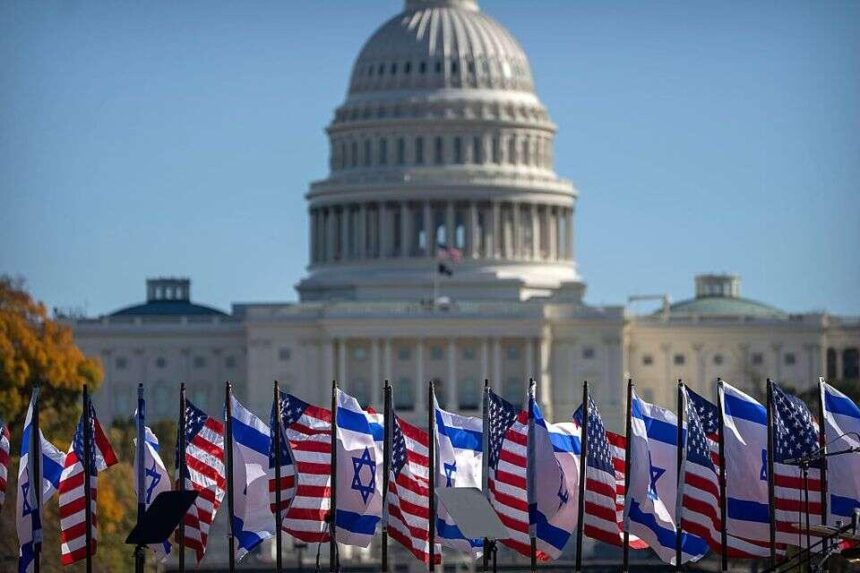
At a moment when Washington’s calculations regarding its global strategic repositioning intersect with shifting power dynamics across the Middle East, the decision to phase out conventional US military aid to Israel emerges as a move that goes well beyond superficial interpretations linking it to political cooling or diplomatic tensions. What appears, at first glance, to be a reduction in financial assistance reveals, at a deeper level, an effort to redefine the rules of engagement and the alliance between the two countries. This emerging framework was reportedly shaped during the meeting between Donald Trump and Benjamin Netanyahu at Mar-a-Lago last January, as the bilateral relationship moves towards a more complex model of strategic and industrial partnership, replacing the traditional donor-recipient arrangement.
Available indications suggest that this shift reflects a comprehensive restructuring of the American presence in the Middle East, consistent with Washington’s broader strategy of redistributing its military weight globally and gradually reducing its direct involvement in the region. Such a recalibration would create greater space for Israel to assume the role of a regional “policeman”, safeguarding Western interests and helping maintain the existing regional order.
This decision does not, however, imply an end to the flow of American weapons to Israel. Rather, it signals a transition towards direct procurement using Israeli financial resources and in accordance with Israel’s own security priorities. Such a shift would free the Israeli military establishment from the political conditionalities and bureaucratic constraints associated with formal aid mechanisms, granting it greater flexibility in managing arms procurement and defence contracts.
This trajectory intersects with Washington’s longstanding strategic pivot towards the Indo-Pacific, where the United States seeks to concentrate its military and strategic resources to counter the growing challenge posed by China. This priority necessitates a reduced direct American commitment to the Middle East and a lighter financial burden associated with maintaining its military presence there. From Washington’s perspective, no regional power matches Israel in terms of readiness and operational capabilities to fill this vacuum and safeguard Western interests, particularly following the expansion of Israel’s regional alliance network and the enhancement of its deterrence capabilities.
This emerging role coincides with Israel’s rise to become the world’s seventh-largest arms exporter and the transformation of its territory into an advanced forward base and strategic stockpile for American military equipment and munitions, positioned close to potential flashpoints. These developments are reinforced by growing industrial and defence integration between the two countries, particularly in air defence systems and the military applications of artificial intelligence. This is an approach increasingly advocated by members of the US Congress and right-wing American organisations, which have called for redirecting security assistance funds towards joint research, development and production programmes.
Under this vision, Israel’s integration into a shared security and commercial framework would allow it to gradually wean itself off direct American military financing, much as it did in the 1990s when it relinquished US economic assistance. The transition would also offer Tel Aviv a significant political advantage by reducing Congress’s leverage to pressure Israeli policies or condition arms deliveries on human rights concerns and Israel’s conduct during military operations and regional crises, particularly amid the growing influence of Democratic constituencies.
On the operational front, a reduced direct American military presence could give Israel greater room for manoeuvre, allowing it to conduct pre-emptive strikes or operations aimed at neutralising regional threats.
Prof. Hatem Sadek, Helwan University