

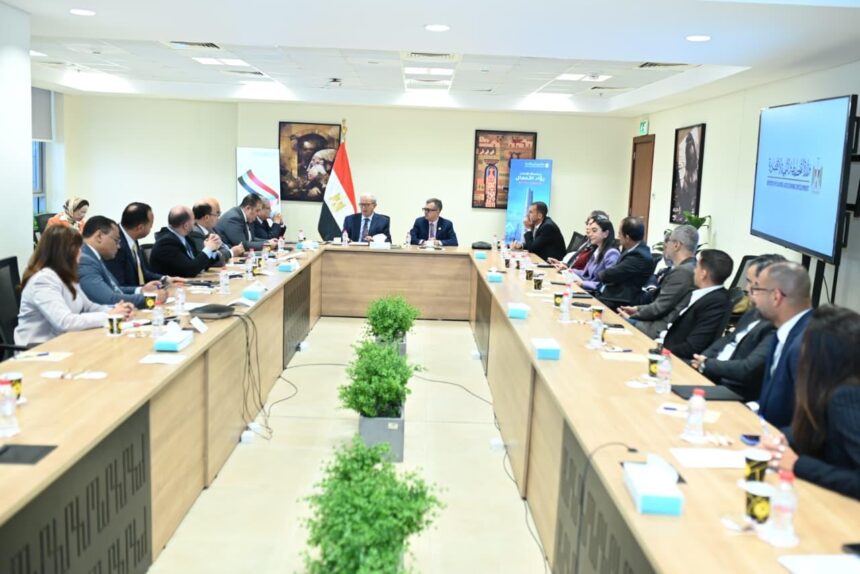
Deputy Prime Minister for Economic Affairs and Chairperson of the Ministerial Group for Entrepreneurship Hussein Eissa and Minister of Planning and Economic Development Ahmed Rostom held two extensive meetings to develop a practical roadmap for accelerating the growth of Egypt’s start-up sector.
The first meeting brought together representatives of venture capital funds and business incubators, while the second involved a group of start-up founders and entrepreneurs, with the aim of hearing their views and practical proposals for advancing the sector.
The meetings were attended by Mostafa El-Hayawan, Chairperson of NI Capital; Mohamed Metwally, the company’s CEO and Managing Director; Saeed Arafa and Mohamed Ayad, Assistant Ministers of Investment and Foreign Trade; and representatives of numerous companies operating in financial technology, educational technology, manufacturing, agricultural technology, telehealth, recruitment and scientific research.
Eissa stressed that the Egyptian government, under the leadership of President Abdel Fattah Al-Sisi, places start-ups and entrepreneurship at the forefront of its priorities, recognising the sector as a key driver of youth participation in economic development through innovative technological solutions, particularly given that young people account for around 60% of Egypt’s population.
He explained that this commitment reflects the sector’s potential to unlock young people’s creative capabilities and drive innovation.
Eissa reaffirmed the government’s commitment to providing comprehensive support to the sector, removing obstacles facing entrepreneurs and listening to the challenges raised by stakeholders, with a view to taking immediate action to address them. He also highlighted the importance of strengthening links between entrepreneurs, universities, scientific research centres and the private sector.
He added that the government was determined to step up efforts to improve and develop the business environment, enabling entrepreneurs to increase their contribution to GDP, create decent employment opportunities and enhance the competitiveness of the national economy.
Eissa noted that the primary objective of the meetings was to gain a direct and detailed understanding of the challenges facing stakeholders across the entrepreneurship ecosystem and address them systematically through the Ministerial Group for Entrepreneurship.
He stressed the government’s commitment to developing joint solutions through close coordination between government entities and the private sector.
For his part, Rostom outlined the implementation measures currently underway, explaining that the governance framework for establishing a dedicated start-up financing fund was being finalised.
The fund will be managed by NI Capital, the investment arm of the National Investment Bank, with contributions from domestic and foreign investors. It aims to increase the value added generated by start-ups and support their expansion in local and regional markets.
Mohamed Metwally, CEO of NI Capital, delivered a presentation outlining the company’s role in managing direct investments and the proposed fund’s operational mechanisms.
Rostom announced that work had begun on establishing sector-specific working groups to bring together start-ups operating in different fields and establish direct, sustained communication channels with the relevant ministries. This will enable the government to intervene promptly to resolve outstanding challenges.
He reaffirmed the ministry’s commitment to implementing the presidential directives issued following the Egypt Forum 2026, highlighting ongoing efforts to operationalise the Qimam programme, which is designed to nurture high-growth start-ups and help them achieve unicorn status.
The programme will be complemented by a package of initiatives aimed at improving the investment climate for start-ups and increasing the contribution of the digital and innovation-driven economy to GDP.
During the meetings, representatives of investment funds and entrepreneurs raised several key issues, foremost among them the need to simplify procedures for start-ups seeking to participate in government tenders and public procurement, address tax and customs challenges, and channel additional financing towards promising sectors facing funding gaps, particularly educational technology.
Participants also stressed the importance of establishing clear exit mechanisms for companies that have reached the expansion stage, which would make the Egyptian market more attractive to foreign investors.
They further called for incentives to enable domestic technology companies to develop import-substituting products and localise manufacturing, alongside closer alignment between university-based scientific research and actual market needs.