

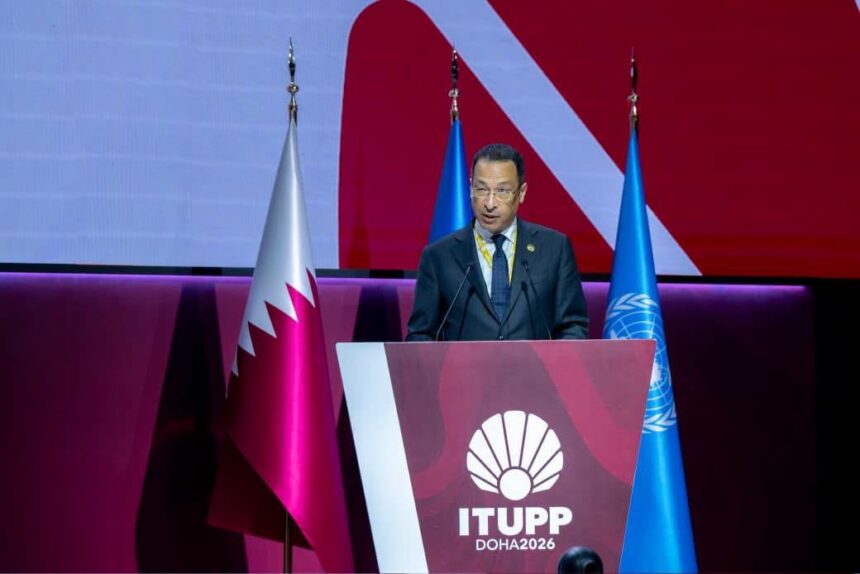
Egypt’s Minister of Communications and Information Technology Raafat Hendy delivered Egypt’s address to the plenary session of the International Telecommunication Union’s Plenipotentiary Conference (PP-26) in Doha, where he announced that Egypt is renewing its candidacy for a seat on the ITU Council representing Africa.
Hendy spoke in the presence of ITU Secretary-General Doreen Bogdan-Martin, alongside representatives of member states, regulators, telecoms and technology companies, universities and international organisations. He thanked Qatar for hosting the conference and asked member states to support Egypt’s bid.
Digital infrastructure and AI
Hendy said Egypt believed affordable, high-quality and secure communications for all were the foundation of inclusive and sustainable development, and that its digital vision matched the two main goals of the ITU’s strategic plan: digital inclusion and sustainable digital transformation.
He said Egypt was expanding its fibre-optic networks, rolling out 5G services and connecting rural and underserved areas to narrow the digital divide. It is implementing a national strategy to move to version 6 of the Internet Protocol (IPv6) and has launched a spectrum strategy for 2026 to 2030.
The minister said Egypt saw connectivity as a way to empower people and improve quality of life, and attached particular importance to artificial intelligence. He pointed to Karnak, an Egyptian large language model developed to support Arabic-language AI applications.
He also noted that several Egyptian initiatives had been recognised in the World Summit on the Information Society (WSIS) Prizes, in areas including the empowerment of women and young people, skills development, digital transformation and online safety.
A long partnership
Hendy highlighted Egypt’s relationship with the ITU, which it joined in 1876, and its membership of the ITU Council since 1947. He said the partnership was growing through work to set up an ITU acceleration and innovation centre in Egypt, the Egyptian-African Centre for Telecom Regulation Training, which has been chosen as a training centre within the ITU Academy, and continuing co-operation on sustainable smart cities.
Talks with Saudi Arabia and Rwanda
On the sidelines of the conference, Hendy met Saudi Arabia’s Minister of Communications and Information Technology Abdullah Alswaha to discuss closer co-operation, particularly in AI. The two reviewed areas covered by a framework memorandum of understanding signed in 2019, which spans AI, digital transformation, postal services, capacity building, innovation and entrepreneurship, and business partnerships.
Hendy briefed his counterpart on upgrades to Egypt’s telecoms infrastructure, including the roll-out of fibre-optic cables nationwide and to villages in the presidential Haya Karima initiative. Alswaha said he wanted to strengthen co-operation and activate the memorandum. The ministers agreed to co-ordinate more closely in international telecoms forums, and Hendy invited Alswaha to visit Egypt.
The meeting was attended by Mohamed Shamroukh, executive president of Egypt’s National Telecom Regulatory Authority, and on the Saudi side by Haytham Al-Ohali, governor of the Communications, Space and Technology Commission.
Hendy also met Rwanda’s Minister of ICT and Innovation Paula Ingabire to discuss co-operation on telecoms infrastructure and AI under a memorandum of understanding the two countries signed in July, as well as co-ordination in international telecoms forums.


