
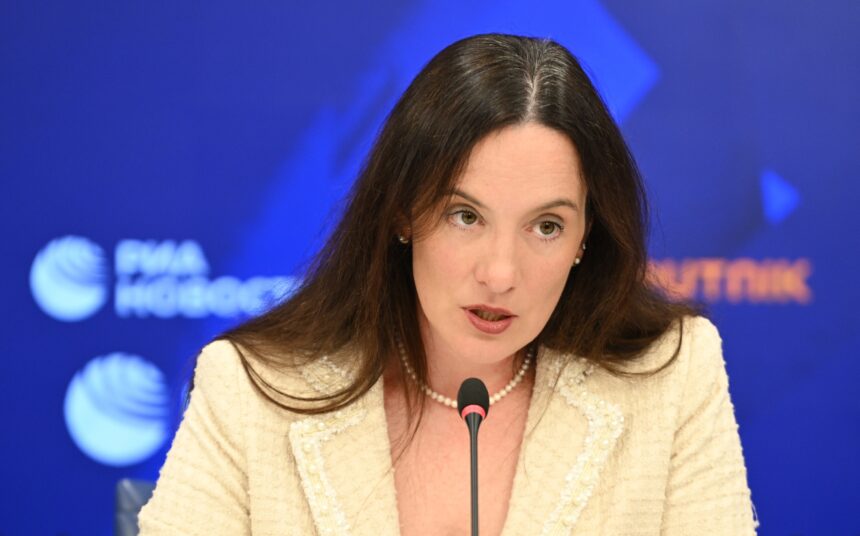
BRICS’ expanding economic influence is creating new opportunities for Egypt to attract investment, diversify trade and strengthen its position as a regional industrial and logistics hub. However, addressing structural challenges, including the trade deficit, weak export performance and debt burden, remains essential to maximising the benefits of membership, Victoria Panova, Head of the BRICS Expert Council – Russia, told Daily News Egypt in an interview.
- How do you assess BRICS’ evolution following its expansion? Has the group succeeded in moving beyond political dialogue to become a more influential force in the global economic system?
- What are the group’s key economic priorities in the coming years, particularly regarding trade, investment and financial cooperation among member states?
- To what extent can BRICS help reshape the international financial system and reduce reliance on traditional financial institutions? What progress has been made in promoting trade settlements in national currencies?
- Following Egypt’s accession to BRICS, what are the most significant economic opportunities available to the country? Which sectors stand to benefit most from deeper cooperation with member states?
- How can Egypt leverage its BRICS membership to boost exports and attract foreign investment, particularly given its strategic geographic location and access to African, Arab and European markets?
- What role could the New Development Bank play in financing infrastructure and development projects in Egypt? Are there opportunities to expand its financing activities in the Egyptian market?
- How do you assess the prospects for expanding Russian investment in Egypt, particularly in sectors such as energy, industry, agriculture and infrastructure?
- Is there significant potential to expand the use of national currencies in Egyptian–Russian trade, and what are the main obstacles to achieving this?
How do you assess BRICS’ evolution following its expansion? Has the group succeeded in moving beyond political dialogue to become a more influential force in the global economic system?
Although some argue that BRICS was initially focused primarily on economics, the group has clearly been active across all three pillars of its cooperation: political, economic and humanitarian. At the same time, it is true that cooperation among its members has gradually intensified and deepened.
Its expansion in 2024–2025, with Egypt, Ethiopia, Iran and the UAE joining, followed by Indonesia, has significantly increased its economic and geopolitical weight. In its expanded format, BRICS is increasingly able to represent the interests of the Global South, or, as I would prefer to call it, the Global Majority. Its member countries are spread across Eurasia, Africa and Latin America, giving the group a broader geographical reach and greater leverage to push for reforms of international institutions, including the UN, IMF and WTO. These reforms aim to ensure a more balanced distribution of voting power, governance structures, shared benefits and responsibilities.
In 2025, BRICS accounted for 39.7% of global GDP at purchasing power parity, representing almost two-fifths of the world economy. Intra-BRICS trade exceeded $1trn, having grown by an annual average of 4.75% over the past five years. The group surpassed the G7 in terms of its share of global GDP much earlier than initially predicted, and experts expect the growth gap between BRICS and G7 economies to widen, further reshaping international trade and the balance of economic influence.
In practical terms, BRICS operates as a networking partnership, combining flexible, club-like mechanisms with firmly established institutions. These include the New Development Bank (NDB), the Contingent Reserve Arrangement (CRA), sectoral working groups, the Vaccine R&D Research Centre, the Network University and the proposed Grain Exchange. Major infrastructure and energy projects are also under way, while an increasing share of trade is being settled in national currencies.
Reaching consensus is not easy, as member countries differ in their levels of development and national priorities, while geopolitical tensions remain. Nevertheless, BRICS continues to strengthen solidarity among its members and work towards more coordinated action.
What are the group’s key economic priorities in the coming years, particularly regarding trade, investment and financial cooperation among member states?
BRICS has set itself a practical agenda focused on reducing vulnerabilities to external pressures and strengthening coordination among its members.
Member countries are gradually removing trade barriers and expanding their economic ties. The figures speak for themselves. Trade between Brazil and China reached $171bn in 2025, up 8.2% from 2024. Growth in trade between Russia and India has been even more striking, with its value increasing almost fivefold in four years.
In terms of investment, the focus is on increasing flows between member countries, including investment in small and medium-sized business projects. Egypt is a good example: investment from BRICS countries in its economy amounted to around $40.6bn in the 2023/24 financial year. This demonstrates how newer members are increasingly emerging as important investment destinations.
Financial infrastructure involves much more than payment instruments. It also encompasses securities depositories, clearing and settlement centres, and mechanisms for verifying transactions. Accordingly, financial cooperation is advancing on several fronts. By 2025, the NDB had approved projects worth a total of $39bn, with a steadily growing share of its operations conducted in national currencies. Meanwhile, the $100bn CRA provides support to member countries facing balance-of-payments difficulties, although this mechanism still needs further development in practical terms.
At the same time, digital initiatives such as central bank digital currency (CBDC) cooperation, BRICS Pay, BRICS Bridge and BRICS Clear are being tested. Over time, they could form an alternative infrastructure for international settlements and reduce BRICS countries’ reliance on Western financial mechanisms. Putting these arrangements into practice will be a long-term undertaking, but their importance should not be underestimated.
To what extent can BRICS help reshape the international financial system and reduce reliance on traditional financial institutions? What progress has been made in promoting trade settlements in national currencies?
As I mentioned earlier, a company’s competitive advantage today depends not simply on the payment instrument it uses, but on its ability to organise the entire transaction chain, meet compliance requirements and ensure the reliable flow of funds. These are the practical challenges shaping a new architecture for international payments, and BRICS is making a gradual but tangible contribution.
Some mechanisms are already addressing real business needs. National currencies now account for 65–67% of settlements in intra-BRICS trade, with the share reaching higher levels in certain bilateral relationships, including around 90% of Russia’s trade with other BRICS countries.
Egypt’s Central Bank has expanded its currency-swap arrangements with China and the UAE. For investors, such arrangements can help reduce exchange-rate risks. This is particularly relevant to Egypt, where foreign-currency shortages have long presented a challenge, as they can make settlements more predictable and lower the costs of entering investment projects.
The NDB offers an alternative source of financing for infrastructure development, with the aim of conducting at least 30% of its investments in national currencies. The CRA is designed to provide short-term liquidity support, helping stabilise countries’ balance-of-payments positions and reduce risks to trade.
Pilot initiatives, including BRICS Bridge for interbank settlements, including those involving digital assets; BRICS Clear for securities custody and transactions; and BRICS Pay, could eventually make cross-border payments easier to process.
It is important to understand that the objective is to build parallel elements of the financial system, not to overhaul the existing system overnight. Progress is constrained by differences in member countries’ interests, unequal liquidity in national currencies and technical barriers. In the coming years, several international payment systems will coexist: some transactions will continue to use traditional channels, while others will increasingly move through BRICS mechanisms.
Following Egypt’s accession to BRICS, what are the most significant economic opportunities available to the country? Which sectors stand to benefit most from deeper cooperation with member states?
First, I would like to stress that countries should move beyond thinking solely in terms of what they give and what they receive. Egypt certainly would not have applied for BRICS membership had it not seen substantial benefits in joining.
However, one important point to remember is that BRICS brings together countries representing the Global Majority. Its membership is not defined by the colonial past that has often complicated relations with former colonial powers. BRICS countries participate on an equal footing, sharing a common Global Majority perspective and working towards the joint objective of achieving a fairer and better world.
BRICS is not based on a donor-recipient model, but rather on horizontal ties and equality.
There is also some confusion between membership of the NDB and membership of BRICS. The NDB is a development bank, and joining BRICS does not automatically confer membership of the bank, although BRICS countries were its founders. As Egypt is already a member of the NDB, it can participate fully in bidding for infrastructure investment projects in the country. Such financing also comes without the Western conditionalities often associated with other sources of funding.
Beyond this, BRICS has worked to intensify cooperation through two Economic Partnership Strategies, covering the periods up to 2020 and 2025. We are now looking forward to the adoption of a third strategy, extending to 2030. These strategies provide a framework for deeper cooperation among member countries and help reduce existing dependencies as economic ties evolve.
While better opportunities for trade and investment within BRICS are undoubtedly important, membership alone will not resolve Egypt’s main economic challenges, including its trade deficit, weak export performance and debt burden. The distinction is straightforward: BRICS can open new opportunities, but modernising the economy remains Cairo’s responsibility.
Egypt is well placed to capitalise on these opportunities because it serves as a natural logistics and economic bridge between BRICS and Africa. Several advantages reinforce this position. The Suez Canal provides a major international trade and logistics route; the African Continental Free Trade Area (AfCFTA) offers access to markets across the continent; and the African Union’s Agenda 2063 sets out long-term development priorities.
Major projects, including the El Dabaa Nuclear Power Plant, the planned Russian Industrial Zone near the Suez Canal, the New Administrative Capital, the Suez Canal Economic Zone and the Space City near Cairo, offer concrete opportunities for cooperation. Together, they strengthen Egypt’s position as a regional hub for energy, industry and logistics while encouraging trade flows in both directions.
How can Egypt leverage its BRICS membership to boost exports and attract foreign investment, particularly given its strategic geographic location and access to African, Arab and European markets?
Beyond energy, industry and logistics, several other sectors offer particularly strong opportunities for Egypt.
Among the most promising are agriculture and food processing, including citrus fruits, vegetables and processed foods, as well as textiles, pharmaceuticals, construction materials and chemicals. Egypt already accounts for more than one-third of Russia’s trade with the entire African continent, demonstrating its role as a gateway to African markets. Closer trade ties with BRICS countries further reinforce this position: in the first half of 2026, Egypt’s trade with the group grew by 25.5%.
Alongside the Russian Industrial Zone near the Suez Canal, Egypt could develop joint ventures in engineering, pharmaceuticals, automotive manufacturing and electronics. BRICS countries are interested in locating production closer to their end markets, including those in Africa. Egypt offers strong logistics connections, a skilled workforce and access to regional markets. This creates opportunities for technology transfer, higher non-commodity exports and job creation.
The greatest benefits are likely to emerge in sectors where Egypt’s natural competitive advantages, including its geographical location, workforce and climate, coincide with growing demand from BRICS economies. These include logistics, energy, agriculture, infrastructure and manufacturing.
What role could the New Development Bank play in financing infrastructure and development projects in Egypt? Are there opportunities to expand its financing activities in the Egyptian market?
At this stage, the NDB represents an additional source of financing for Egypt, with considerable room for expansion, although its practical reach remains limited.
The clearest example is the Suez Wind Farm, for which the NDB was one of the key financing partners in a syndicated financing package exceeding $1bn. Other participants included the African Development Bank (AfDB), the European Bank for Reconstruction and Development (EBRD), British International Investment (BII), DEG, the OPEC Fund and APICORP.
This is particularly important for green-energy projects, as longer loan tenures are better suited to the extended payback periods associated with renewable energy investments. Meanwhile, settlements in national currencies can help reduce exchange-rate risks for contractors.
The NDB’s value lies precisely in areas that the World Bank, AfDB and EBRD do not fully cover, including long-term financing, faster approval processes, co-financing and lending in national currencies.
Over the next few years, the bank could emerge as a significant regional player, particularly in green energy, logistics infrastructure around the Suez Canal, and local-currency lending to the private sector and public-private partnerships.
How do you assess the prospects for expanding Russian investment in Egypt, particularly in sectors such as energy, industry, agriculture and infrastructure?
Around 500 Russian companies operate in the Egyptian market, and Egypt remains one of the main focuses of Russia’s investment policy in the Arab world. However, any substantial expansion will depend less on political will, which is not lacking, than on access to financing, geopolitical tensions and the impact of what I would describe as unfair Western sanctions, as well as Egypt’s own currency challenges.
The outlook differs considerably from one sector to another. Energy offers the most mature and stable model of cooperation. The El Dabaa Nuclear Power Plant is not merely a construction project; it involves a long-term cycle of services, generating sustained demand for technology, fuel and maintenance. In effect, it is a flagship project that helps build confidence in Russian engineering across the Arab world.
The industrial sector presents a different picture. The Russian Industrial Zone in the Suez Canal Economic Zone offers clear incentives, including tax holidays, simplified procedures and access to Egypt’s network of trade agreements. However, progress in attracting resident companies has been moderate. The main constraint is not a lack of incentives, but currency and financial risks, together with the complexity of cross-border settlements.
Agriculture and logistics are perhaps the most practical areas for further growth. We already have a well-established trading relationship, particularly in grain. Bilateral agricultural trade increased by 15% in January–April 2026, while Russian wheat exports to Egypt rose by 19%.
Further infrastructure development that creates wider opportunities for Egypt while safeguarding Russia’s long-term interests should also be considered. Such projects could be large and capital-intensive or more operational in nature, but they should serve the interests of both countries.
In broader infrastructure, including ports, roads and rail hubs, most financing comes from other partners, notably the UAE, Saudi Arabia and China. Russian companies would be better positioned to pursue targeted projects where their engineering expertise offers a particular advantage or where they can build on existing contracts. Logistics supporting grain exports and services linked to the nuclear power plant are good examples.
There is, therefore, genuine potential for growth, but not across the board. The strongest opportunities lie in areas where Russia has a technological or logistical advantage, rather than in a blanket expansion of investment across every sector.
Is there significant potential to expand the use of national currencies in Egyptian–Russian trade, and what are the main obstacles to achieving this?
The shift towards national currencies in Russian-Egyptian trade is no longer a question of whether it will happen, but rather how quickly, through which mechanisms and in which sectors.
According to Russia’s Ministry of Industry and Trade, around 40% of bilateral settlements are already conducted in national or other ‘friendly’ currencies. Stable grain exports are a major driver of this trend.
Tourism, which brings nearly two million Russian visitors to Egypt annually, generates a counterflow of Egyptian pounds, helping to offset part of the trade imbalance. Egypt’s BRICS membership and the broader regional drive towards reducing reliance on the US dollar provide additional momentum.
The share of settlements in national currencies could rise to 50-60%, mainly by expanding mechanisms that are already working, including grain contracts, tourism payments and servicing arrangements for major projects. ‘Bridge’ currencies, such as the Chinese yuan and the UAE dirham, will continue to play a role in balancing payment flows.
However, putting the proposed BRICS payment system into practice is undoubtedly a long-term undertaking. Its multilateral design could also help mitigate the risks arising from trade imbalances, which exist in bilateral trade between our countries.
A currency-swap agreement between the Russian and Egyptian central banks would be an important catalyst for increasing the share of settlements in national currencies, but it would not guarantee a breakthrough on its own. Greater exports in the opposite direction, hedging instruments and banking facilities for settlements would also be necessary.
The market is moving, and I hope we will hear some good news soon.