

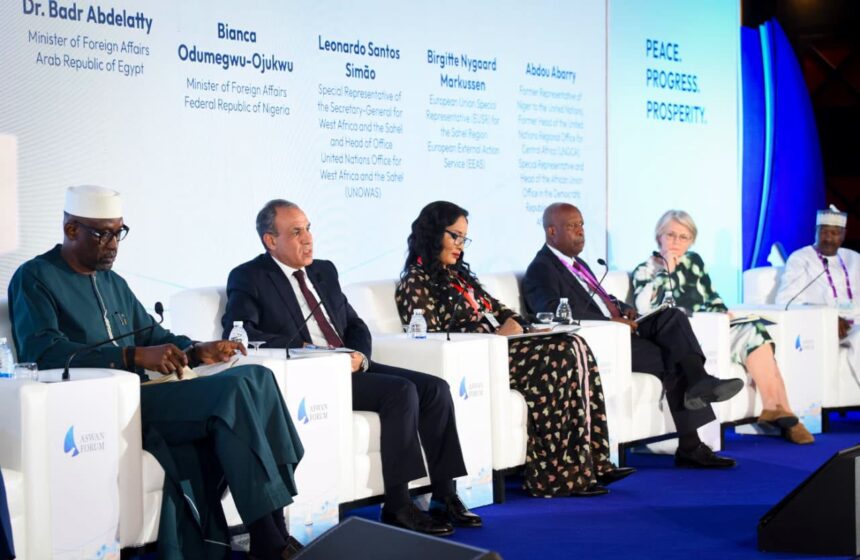
Egyptian Foreign Minister Badr Abdelatty took part in a series of sessions and meetings at the Aswan Forum for Sustainable Peace and Development on Sunday, addressing counterterrorism in the Sahel, security in the Middle East, relations with Nigeria and Mali, and the role of the Cairo International Center for Conflict Resolution, Peacekeeping and Peacebuilding.
During a session on development and counterterrorism in the Sahel, Abdelatty said lasting stability required an integrated approach combining security, ideological and development measures and addressing the underlying causes of terrorism and instability.
He said development offered the most sustainable foundation for security by transforming natural resources into economic opportunities, creating jobs and improving living standards.
Abdelatty called for stronger African institutional frameworks and a greater role for the African Union and mechanisms under the Community of Sahel-Saharan States.
He highlighted the Cairo-based counterterrorism centre of the Community of Sahel-Saharan States as a mechanism for regional coordination, capacity building and information exchange.
Abdelatty also reviewed Egypt’s cooperation with Sahel countries in security, counterterrorism and capacity building, citing Al-Azhar’s efforts to counter extremist ideology, training programmes run by the Egyptian Agency of Partnership for Development, and the involvement of Egyptian companies in energy, infrastructure and development projects.
He said Egypt sought to expand its partnerships with Sahel states by combining security cooperation with investment, economic integration and sustainable development.
In a separate discussion titled “Beyond the Ceasefire: Towards a Peace Architecture for the Middle East,” Abdelatty said successive regional crises had demonstrated, in Egypt’s view, that military solutions could not deliver sustainable settlements.
He outlined four principles underpinning Egypt’s approach to regional peace.
The first involves moving from ceasefires to clear political processes that address the root causes of conflicts.
On Gaza, Abdelatty called for the full implementation of the second phase of US President Donald Trump’s peace plan, including, according to the Egyptian statement, the withdrawal of Israeli forces, enabling a national committee to administer Gaza, accelerating early recovery and reconstruction efforts, and ultimately establishing an independent Palestinian state along the June 4, 1967 lines, with East Jerusalem as its capital.
The second principle, he said, is supporting national state institutions, sovereignty and territorial integrity.
He called for supporting Lebanese state institutions and ensuring the full implementation of UN Security Council Resolution 1701, preserving Syria’s unity and sovereignty, achieving a comprehensive political settlement in Yemen, and maintaining de-escalation and dialogue in addressing tensions involving Iran.
Abdelatty said Egypt viewed its security as closely linked to that of the Gulf states and the wider region.
The third principle, he said, is the need for clear guarantees, monitoring and accountability mechanisms to ensure the implementation of ceasefire agreements and political settlements, alongside respect for international law and UN Security Council resolutions without double standards.
The fourth principle involves greater regional ownership of Middle East security arrangements, with countries in the region taking the lead in shaping security frameworks and protecting strategic waterways, particularly the Red Sea and the Gulf of Aden.
Abdelatty called for shifting from managing crises after they erupt to preventing them, and from temporary arrangements to comprehensive political settlements.
On the sidelines of the forum, Abdelatty chaired a meeting of the advisory council of the Cairo International Center for Conflict Resolution, Peacekeeping and Peacebuilding.
The meeting saw the launch of a joint international advisory council for the Cairo Center and the Aswan Forum, with former Egyptian Foreign Minister and former Arab League Secretary-General Amr Moussa named honorary chairman.
Abdelatty said the initiative aimed to strengthen coordination between the centre and the forum, expand international partnerships and translate forum discussions into practical initiatives in peace, security and development.
He also met with Nigerian Foreign Minister Bianca Ojukwu to discuss trade, investment, agriculture, cultural ties and capacity building.
Abdelatty said Egypt hoped to hold the next round of ministerial-level political consultations in Abuja and called for increased trade between Egypt and Nigeria, describing them as two of Africa’s largest economies.
The two ministers also discussed developments in West Africa and the Sahel, with Abdelatty reiterating Egypt’s support for counterterrorism efforts and calling for approaches that combine security and development.
In a separate meeting with Malian Foreign Minister Abdoulaye Diop, Abdelatty called for convening the two countries’ joint committee as soon as possible, alongside efforts to increase trade, encourage investment and expand the participation of Egyptian companies in development projects in Mali.
He reiterated Egypt’s support for counterterrorism efforts in the Sahel and called for continued cooperation through security, ideological and development measures, including greater use of Egyptian capacity-building programmes, particularly those run by Al-Azhar.
The meetings were held on the second day of the sixth Aswan Forum for Sustainable Peace and Development, which is focusing this year on security and development challenges in Africa and the Middle East amid mounting geopolitical and economic pressures.
