

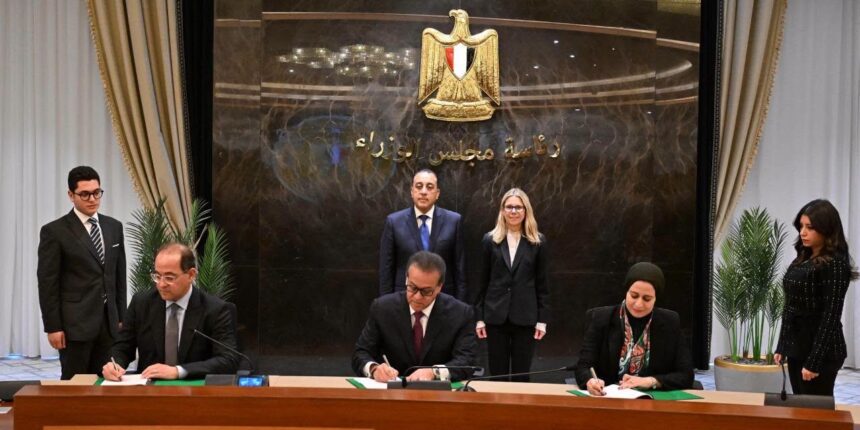
Egypt has signed a national compact with the World Bank Group to accelerate the expansion of its Universal Health Insurance System, targeting an additional 18.5 million beneficiaries across six governorates by 2030, according to a Cabinet statement.
Prime Minister Mostafa Madbouly witnessed the signing of the Egypt National Health Compact, which was signed by Health and Population Minister Khaled Abdel Ghaffar, Finance Minister Ahmed Kouchouk, and Deputy Foreign Minister for International Cooperation Samar El-Ahdal.
The second phase of the system will cover six additional governorates: Damietta, Kafr El-Sheikh, Minya, Matrouh, North Sinai and Alexandria. The expansion is expected to bring the total number of targeted beneficiaries across the first and second phases to approximately 23.5 million.
Under the compact, the government plans to develop and upgrade 935 healthcare facilities in the targeted governorates, including 827 primary healthcare facilities and 108 hospitals and critical care units, preparing them to deliver services in line with national accreditation standards.
The agreement also aims to reduce citizens’ out-of-pocket healthcare spending to less than 28% of total health expenditure in the targeted governorates, while strengthening financial protection for households against healthcare costs.
It further targets raising the share of locally produced essential medicines and healthcare products to more than 75% by value and over 90% by volume, while improving the availability of essential medicines at primary healthcare facilities.
The expansion is expected to require around EGP 178bn in financing through 2030, comprising approximately EGP 163bn from the public sector and EGP 15bn from the private sector, to cover the necessary infrastructure investments and operating costs.
Madbouly said accelerating the implementation of the Universal Health Insurance System is a key government priority, describing it as a major healthcare and social reform initiative aimed at ensuring access to integrated, high-quality medical services without placing financial burdens on citizens and their families.
He added that the government is working to meet the requirements for expansion by upgrading healthcare infrastructure, improving facility readiness, securing qualified personnel and ensuring sustainable financing.
Health and Population Minister Khaled Abdel Ghaffar said the compact would support the completion of the system’s rollout through coordinated efforts to upgrade healthcare facilities, improve primary care services, develop the health workforce and enhance the readiness of hospitals and service providers.
For his part, Finance Minister Ahmed Kouchouk stressed the importance of ensuring sustainable financing for healthcare development, improving the allocation and efficiency of public spending, and securing the necessary funding to cover contributions on behalf of eligible low-income groups. He also highlighted the importance of encouraging private investment in the healthcare sector.
The compact is built around six strategic pillars: healthcare infrastructure and facility readiness; expansion of primary, community-based and telemedicine services; development of essential healthcare benefits and preventive services; investment in the health workforce; financial protection and access to care; and greater private-sector participation, investment and innovation.
The government will establish a joint monitoring, evaluation and accountability framework in coordination with the Ministry of Health and Population, the Universal Health Insurance Authority, the General Authority for Healthcare and other relevant entities, with the participation of the World Bank Group and development partners.
The framework will rely on performance indicators and specific timelines to track geographic expansion, facility readiness, beneficiary registration, financing availability and service quality.


