

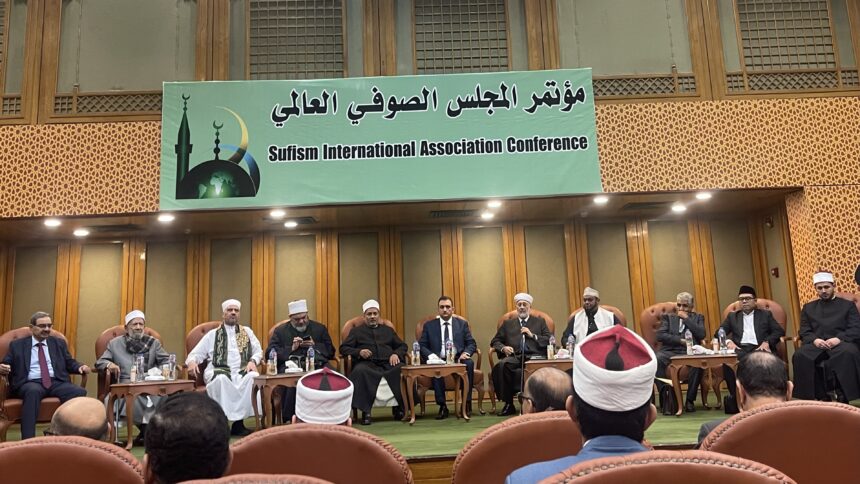
The Sufism International Association formally relaunched on Saturday at the Al-Azhar Conference Centre in Cairo. Delegations from around 50 countries attended, and speakers repeatedly presented Egypt as the spiritual and scholarly centre of Sunni Sufism.
“Sufism is not a slogan to be raised, nor an appearance to be seen,” said Ramy El-Shahawy, the association’s president and head of the Shahawiyya Burhamiyya order. “It is steadfastness upon the Sharia, sincerity in servitude, purification of the soul, elevation of character and the attainment of excellence.”
El-Shahawy, who also addressed members of Egypt’s Supreme Council for Sufi Orders in the hall, called Egypt “the land of leadership” and the home of Al-Azhar. He set strict limits on the path the association would follow: “There is no Sufism without knowledge that guides, no spiritual path without law that governs it, and no purification without following the guidance of the Prophet.”
He said the deviations attached to some practices were “empty appearances that religion and reason reject” and had nothing to do with the essence of Sufism. The association’s approach, he said, rests on the Quran and the Sunnah, “love of the Prophet’s family without excess or neglect”, and reverence for all the Companions, led by the four Rightly Guided Caliphs. “True Sufism has no connection to any alien thought that touches the creed of the nation or stirs strife among its people,” he said.
El-Shahawy said Sufism’s mission now goes beyond individual spiritual training. He described it as “an impregnable fortress” protecting young people from “currents of extremism, atheism and moral decay”. The association’s purpose is “not merely to gather names under one umbrella, but to gather hearts upon the truth”, he said. He pledged to protect religion “from distortion, superstition and innovation” and to offer a discourse “that unites and does not divide, builds and does not destroy”.
Mohamed Wesam spoke on behalf of Egypt’s Grand Mufti, Nazir Mohamed Ayyad. “If Sufism is global in its message, it is Egyptian at heart,” he said.
“Sufism is a science”
The senior Azhari scholar Sheikh Abdel Aziz El-Shahawy defended Sufism as a scholarly discipline. “Sufism is a science like any other, like grammar, rhetoric and jurisprudence,” he said. “It has its people, its scholars and its books,” and he cited al-Qushayri’s Risala and al-Ghazali’s Revival of the Religious Sciences. “Do not listen to these ignorant people who attack Sufism,” he told the audience.
Quoting Imam al-Shafi’i’s advice to be “a jurist and a Sufi” at once, he said knowing the diseases of the heart, such as envy, arrogance and showing off, is an obligation on every Muslim. He defined Sufism as emptying the soul of blameworthy traits and adorning it with noble ones. Asceticism, he added, means “the heart is not attached to money. Having money does no harm.” He closed with a prayer for Egypt, its army, its president and its government.
A body revived
Sheikh Mohamed El-Shahawy, Ramy’s late father, founded the association in 2008. Its administrative centre is in London and its executive centre in Cairo. Organisers said Egypt accredited the association in 2012, and a press release said it now operates under a formal agreement with Egypt’s Foreign Ministry. The release described the conference as a resumption of the association’s activities. In its closing statement, the association announced its “launch and founding” and called the day a historic achievement.
The association follows the Ash’ari and Maturidi creeds and the four Sunni schools of law, the same framework taught at Al-Azhar.
International voices
Mohamed Hussein al-Arab, president of the Council of Muftis in America, thanked President Abdel Fattah al-Sisi for his “gracious patronage” of the event. He said the association’s next gathering could be held in the US. “If Mecca is the qibla of bodies, then the land of Egypt and its Azhar is the qibla of souls,” he said.
Speaking for the Maghreb delegations, Abdel Nabi Abu Gharara, dean of the Faculty of Human and Applied Studies at Zaytuna University in Tunisia, put three recommendations to the association. He urged it to tie Sufi studies to rigorous academic method, so that practices foreign to the faith can be purged. He asked it to stress Sufism’s ethical role against both extremism and materialism. He also called on it to build partnerships with universities and research centres to revive moderate Sufi heritage “in the language of the age”.
Fouad Safiullah of Indonesia’s Nahdlatul Ulama spoke on behalf of the Asian delegations. He noted that the organisation’s founder, Hasyim Asy’ari, named Abu al-Hasan al-Shadhili and al-Ghazali as the Sufi masters followed in Java. He called that a sign of the deep ties between Indonesia and Egypt.
Kenyan scholar Amer Hassan al-Nahdi spoke for Kenya’s scholars and for Kenyan students at Al-Azhar, and announced that they were joining the association. He described the relaunch as a step towards “uniting ranks” at a time when it was badly needed.
The event witnessed participating countries from Central Asia, the Balkans and the Horn of Africa, including Somalia, Eritrea, Djibouti and Sudan, as well as China, Russia, the UK and the US.

