

The Suez Canal Economic Zone (SCZONE) is seeking to expand economic cooperation with Greek companies in the industrial, maritime and logistics sectors, as part of efforts to attract further Greek investment and strengthen Egypt’s position as a regional hub for production and exports to European markets.
Mostafa Shekhon, Chairperson of Suez Canal Economic Zone, made the remarks during the first Egyptian-Greek Economic Diplomacy Forum, held in Athens on November 19-20, as part of a high-level Egyptian delegation headed by Finance Minister Ahmed Kouchouk.
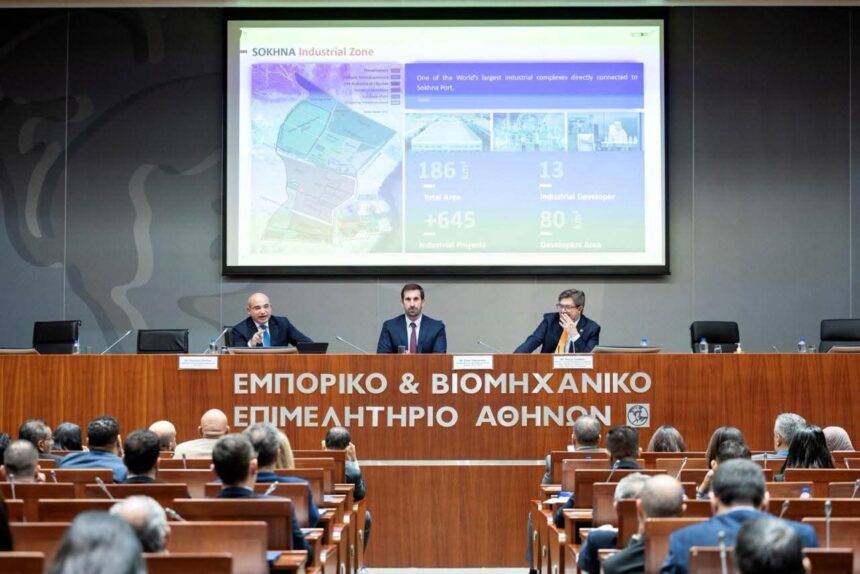
During the forum, Shekhon participated in a panel discussion on SCZONE as a platform for production and exports to European markets, where he outlined the zone’s investment advantages, incentives, infrastructure readiness and integration between its ports on the Mediterranean and Red Seas and its industrial zones on both sides of the Suez Canal.
He also highlighted opportunities for cooperation with Greek companies in maritime transport, port operations and logistics services, including conventional and green marine fuel bunkering.
Shekhon said the economic partnership between Egypt and Greece was built on longstanding historical and cultural ties, stressing that SCZONE was keen to benefit from Greek companies’ expertise and their access to European markets.
He added that the zone offered competitive advantages that could help address disruptions in global supply chains, including ready-to-use infrastructure and utilities, available energy resources and skilled technical labour at competitive costs.
On the sidelines of the forum, Shekhon held bilateral meetings with Greek Minister of Economy and Finance Kyriakos Pierrakakis and Greece’s Deputy Foreign Minister for Economic Affairs to discuss ways to strengthen bilateral economic and investment cooperation and attract Greek investments to targeted sectors within SCZONE.
The discussions also addressed the role of government support and closer coordination between SCZONE and Greek companies in addressing current geopolitical challenges.
On the forum’s second day, Shekhon participated in a session titled “Deepening the Strategic Economic Partnership between Egypt and Greece” and spoke at a panel discussion titled “The Suez Canal: A Strategic Corridor for Trade and Investment”.
The panel examined the future of maritime navigation and international trade, as well as the roles of Egypt and Greece in securing maritime corridors and supporting regional and global trade flows.
Participants included Greek Minister of Maritime Affairs and Island Policy Vasilis Kikilias, Union of Greek Shipowners President Melina Travlos, Orascom Industrial Parks CEO Amr El-Batrik, and representatives of Egyptian and Greek companies and port authorities.
Shekhon said the forum should serve as a starting point for sustained follow-up and institutional coordination among SCZONE, the Greek Chamber of Commerce, the Egyptian Embassy in Athens, the Commercial Representation Office and the Egyptian Junior Business Association (EJB).
He said this coordination would help translate investment interest into concrete contracts and projects.
Shekhon also held meetings with representatives of Greek investment and business groups, including Seif El-Khawanky of Broadmore Consulting, Dimitris Kopelouzos, Chairperson of the Kopelouzos Group, and Vyron Vasileiadis, founder and chairperson of Vasileiadis Group (V Group), presenting the zone’s investment opportunities across industrial, logistics and service sectors.
He invited Greek companies and investment groups to visit SCZONE to explore its infrastructure, ongoing developments and the experience of its international partners, reiterating the authority’s readiness to support prospective investors.
The forum concluded with a session titled “Turning Economic Integration into Joint Projects: Sectoral Cooperation between Egypt and Greece”, which focused on translating opportunities in industry, logistics and maritime ports into actionable joint projects and investments.
The session also addressed recommendations and mechanisms for following up on their implementation and maintaining bilateral communication.


