

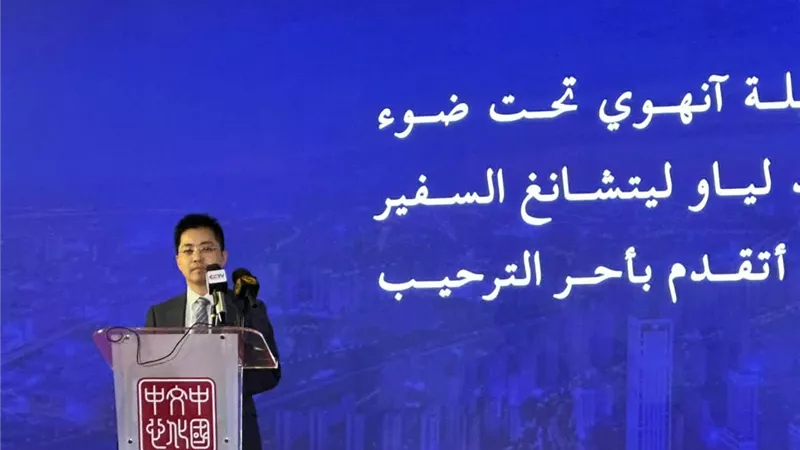
Cultural diplomacy is no longer confined to projecting national images or introducing audiences to a country’s heritage. It has increasingly become an entry point for building relationships in which culture, education, scientific research and economic cooperation intersect. Familiarity between societies does more than create space for mutual understanding; it can also establish channels of communication among institutions, universities and businesses, laying the groundwork for partnerships that may develop into investment and development opportunities. From this perspective, the evening organised by the Chinese Embassy in Cairo on Monday, 23 November, under the title “Anhui Night Under the Full Moon”, can be understood as more than an artistic celebration or an exercise in tourism promotion. It offered an opportunity to introduce an important Chinese province with a distinctive cultural and historical legacy, as well as substantial academic, technological and industrial capabilities that could open broader avenues for long-term economic cooperation, extending well beyond short-term tourist exchanges.
Attended by Chinese Ambassador to Egypt Liao Liqiang and Egypt’s Minister of Culture and former Prime Minister Essam Sharaf, alongside academics, investors and representatives of the tourism sector, the event brought together artistic performances, an exhibition of traditional crafts and heritage, local cuisine and presentations of the province’s tourism assets. The choice of Anhui as the focus of the evening was far from incidental. It reflected a broader Chinese approach to presenting its provinces and regions as entities with distinctive identities, resources and economic advantages, each capable of developing international partnerships on the basis of its own local strengths. Through this approach, China does not simply present itself as a major global power; it also gives international partners an opportunity to explore the diversity within the country and to understand what individual regions can offer in culture, education and investment.
Anhui provides a particularly rich illustration of this diversity. Located in eastern China, between the basins of the Yangtze and Huai Rivers, the province covers approximately 140,000 square kilometres and has a population of more than 60 million. Its capital, Hefei, has developed into a significant urban, scientific and industrial centre. Anhui’s cultural identity is strongly associated with the historic Huizhou tradition, which has shaped its commercial life, arts, architecture and educational heritage. The province is also home to Mount Huangshan, renowned for its striking natural landscapes, and the historic villages of Xidi and Hongcun, both inscribed on UNESCO’s World Heritage List. Their traditional architecture, ancestral halls and sophisticated water systems offer a glimpse into the social history and cultural values of the region.

Anhui’s heritage, however, extends well beyond its historic sites. The province is among China’s most prominent centres of traditional craftsmanship and artistic production. Its distinctive crafts include Xuan paper, widely used in Chinese calligraphy and painting; Hui ink; She inkstones; and intricate wood, stone and brick carvings. Anhui is also known for Huangmei opera and Hui opera, as well as its tea culture, which includes celebrated varieties such as Huangshan Maofeng and Qimen black tea. This cultural wealth offers scope for cooperation in the cultural and creative industries, the preservation of intangible heritage, digital documentation, traditional crafts, and the design and marketing of cultural products. These are fields in which artistic expertise can intersect with tangible economic opportunities.
Perhaps the most significant aspect of Anhui’s experience, however, is its ability to bring a deep-rooted cultural heritage into dialogue with modern scientific and industrial development. Hefei is home to the University of Science and Technology of China, one of the country’s leading academic and research institutions, as well as Anhui University, Hefei University of Technology and other universities specialising in engineering, science, medicine and agriculture. This concentration of academic and research institutions has helped support the province’s progress in quantum technology, semiconductors, artificial intelligence and biomedicine, alongside the development of electric vehicles, batteries, renewable energy, robotics and electronic displays. Anhui thus illustrates a model of development in which investment in knowledge is closely connected to the expansion of industrial capacity, and cultural identity is not treated as separate from the demands of a modern economy.
This is where the educational dimension of Egyptian-Chinese cooperation assumes particular importance. Partnerships between universities and research institutions can provide some of the most effective foundations for lasting relationships, provided they move beyond ceremonial visits and official delegations towards joint teaching, research and training programmes, student and faculty exchanges, and the development of academic and professional curricula that respond to the needs of economic sectors. Such cooperation could encompass tourism, heritage management, archaeology, the arts and translation, alongside technology, engineering, energy and applied sciences. Anhui’s experience also offers an opportunity to consider how Egyptian universities might establish stronger links with Chinese research and industrial centres, ensuring that academic cooperation is not disconnected from the needs of businesses and the labour market.
The significance of this approach extends beyond education itself. University and research partnerships can help create a more favourable environment for investment by developing professional skills, facilitating the exchange of knowledge and producing technological solutions with practical applications. Culture, meanwhile, can play an economic role that goes beyond the organisation of events. It can support creative industries, strengthen traditional crafts and heritage-based products, and help them reach new markets. Tourism is another sector in which these elements converge. Cooperation in cultural marketing, heritage-site management and professional training can attract more visitors while increasing the economic returns generated by hospitality, transport and related services.
In this context, Egyptian-Chinese cooperation should not be assessed solely in terms of investment volumes or the number of agreements announced. Equal attention should be given to the potential economic value that cultural and educational partnerships can generate. What is needed is a stronger network connecting universities, research centres and the private sector; greater encouragement for companies to draw on local expertise; and training and knowledge-exchange programmes linked to practical projects. The closer cooperation in research and education is aligned with the needs of production and services, the greater the likelihood that it will generate sustainable economic returns for both countries.
In this sense, Anhui Night offers a useful perspective on a distinctive model of China’s international outreach: one that presents a province through the breadth of its history, arts, educational institutions and industrial capabilities, using cultural engagement as a starting point for exploring wider opportunities for cooperation. For Egypt, the value of such initiatives lies not merely in becoming acquainted with the assets of a particular Chinese province, but in translating that familiarity into direct partnerships among cultural institutions, universities, research centres and investors.
Culture opens channels of communication; education builds knowledge, trust and human capacity; and the economy provides these relationships with opportunities for practical application and growth. Maximising the returns of Egyptian-Chinese cooperation therefore requires treating these fields as interconnected components rather than separate tracks. The ultimate objective should be to turn cultural affinity into institutional cooperation, academic collaboration into opportunities for innovation and production, and economic engagement into partnerships that generate genuine added value for both sides.
Dr Marwa El-Shinawy, academic and writer


