

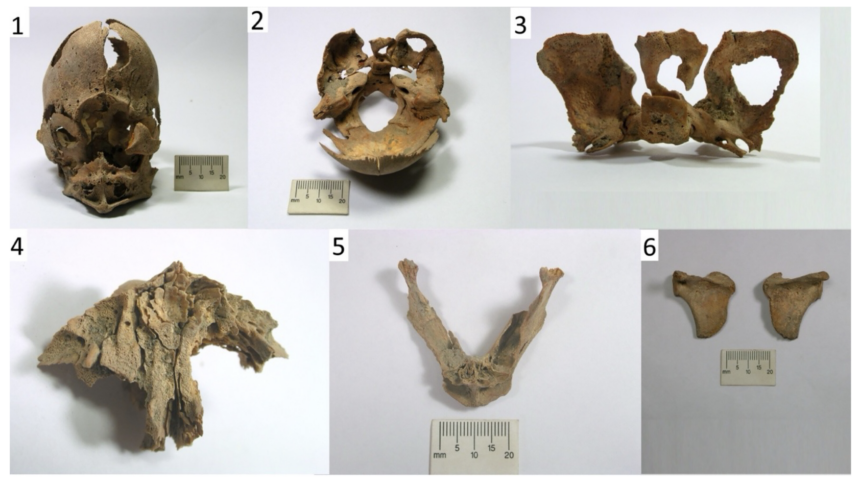
Around 1,600 years ago, two baby girls were buried together inside a ceramic vessel in the Palpa Valley of southern Peru, in a cemetery belonging to the ancient Nazca civilization. One of the infants, however, had a highly unusual physical condition. Her skull featured a single eye socket positioned in the centre of her face, alongside severe abnormalities affecting her skull and facial bones.
Centuries later, researchers successfully extracted ancient DNA from her remains, revealing that she carried an extra copy of chromosome 13, a genetic abnormality known as trisomy 13. The condition was most likely responsible for an extremely rare congenital disorder called cyclopia, in which the developing fetus forms a single central eye structure rather than two separate eyes.
Elsa Tomasto-Cagigao, a researcher in Andean studies at the Department of Humanities of the Pontifical Catholic University of Peru and lead author of the study, recently published in the journal Proceedings of the National Academy of Sciences (PNAS), explains that skeletal abnormalities alone cannot establish whether an individual was regarded as different, considered disabled or provided with special care.
The significance attached to physical differences, she notes, varies considerably across societies and historical periods.
An Unexpected Discovery in an Ancient Grave
According to Tomasto-Cagigao, the researchers brought together three types of evidence to reconstruct the infant’s story: skeletal anatomy, ancient DNA and burial practices.
Cyclopia is an extreme form of a developmental disorder known as holoprosencephaly, in which the forebrain fails to divide properly during early fetal development. The condition occurs in approximately one in every 100,000 births and is usually fatal before birth or shortly afterwards.
Trisomy 13 is one of its major genetic causes, accounting for an estimated 17% to 39% of severe cases.
The remains were discovered in Tomb 25 at the Jauranga archaeological site in Peru’s Palpa Valley, dating to the Middle Nazca period, approximately 325-440 CE.
The grave contained the skeletons of two infants placed one above the other inside a ceramic vessel, with no additional grave goods.
Although such a burial might appear unusual today, the practice was relatively common in Nazca society. According to the study, approximately one-quarter of documented Nazca burials in Palpa involved ceramic vessels, which were generally used for children younger than six.
Both skeletons were relatively well preserved. However, one infant, identified by the researchers as JA13A, displayed striking anatomical abnormalities.
Her skull was unusually small, with a single centrally positioned eye socket and missing nasal bones and other midfacial structures. She also had additional abnormalities affecting her vertebrae, shoulders and skull.
Taken together, these skeletal features strongly supported a diagnosis of cyclopia.
To investigate the condition further, the researchers extracted ancient DNA from the leg bones of both infants and examined the genetic material using several independent analytical methods.
The results confirmed that both children were female. However, they carried different mitochondrial DNA lineages, ruling out the possibility that they shared the same biological mother.
The most significant discovery came from the analysis of their chromosome numbers.
Three independent analytical methods confirmed that JA13A had three copies of chromosome 13 instead of the usual two, providing direct genetic evidence of trisomy 13.
This finding established a link between the infant’s unusual skeletal anatomy and a specific chromosomal abnormality, allowing researchers to move beyond a diagnosis based solely on the physical appearance of her remains.
Did the Baby Survive After Birth?
One of the most intriguing questions raised by the discovery concerns how long the infant may have lived.
Tomasto-Cagigao explains that the development of the child’s teeth suggests she may have survived for approximately two to four months after birth.
However, measurements of her long bones indicate a developmental stage closer to the end of pregnancy, corresponding to roughly 36 to 40 weeks of gestation.
This discrepancy raises two possible explanations.
The infant may indeed have survived for several months after birth. Alternatively, trisomy 13 and the associated abnormalities in brain and facial development may have affected the normal growth rates of her teeth and bones, making conventional age-estimation methods less reliable.
Consequently, the researchers cannot establish her precise age at death.
The archaeological evidence also raises questions about how the child’s community responded to her physical differences.
Despite her severe congenital abnormalities, the infant was not given an obviously different burial from those of other children in Middle Nazca society.
Burial inside ceramic vessels was already an established funerary practice in the region, and comparable graves were often simple and contained no offerings.
The researchers suggest that this indicates, at the very least, that the infant’s condition did not prevent her from being included in customary funerary practices for children.
However, they stress that burial practices alone cannot establish whether she was socially accepted, regarded as different or provided with special care during her lifetime.
The fact that she was buried alongside another infant who did not share her maternal lineage also remains unexplained.
What the Discovery Cannot Tell Us
Despite the remarkable combination of skeletal and genetic evidence, the study has several limitations.
First, it examines only one individual. The findings therefore cannot be used to estimate how common trisomy 13 or cyclopia was among the Nazca population.
Second, researchers cannot determine the infant’s precise age at death because the genetic condition itself may have affected the development of her teeth and bones.
Third, the archaeological record provides no direct evidence of the level of care she received, her social status or how her community interpreted her physical appearance.
Nor can the researchers explain why the two infants, who were not maternally related, were buried together.
Tomasto-Cagigao and her colleagues also caution against drawing conclusions based on evidence from other ancient Andean societies.
Although some archaeological and historical studies have suggested that people with physical differences received care or occupied particular social roles in certain Andean communities, such interpretations cannot automatically be applied to Middle Nazca society.
These communities existed in different periods and had distinct cultural traditions, making direct comparisons potentially misleading.
Nevertheless, the discovery demonstrates how combining ancient DNA analysis with traditional archaeological methods can reveal aspects of prehistoric human health that would otherwise remain hidden.
More importantly, it offers a rare opportunity to examine the relationship between a severe genetic disorder, the physical remains of an ancient individual and the funerary customs of the society in which she lived.
Although the infant’s short life and the circumstances surrounding her burial remain largely unknown, the discovery provides compelling evidence that congenital genetic conditions existed long before modern medicine developed the tools to identify them.


